Introduction
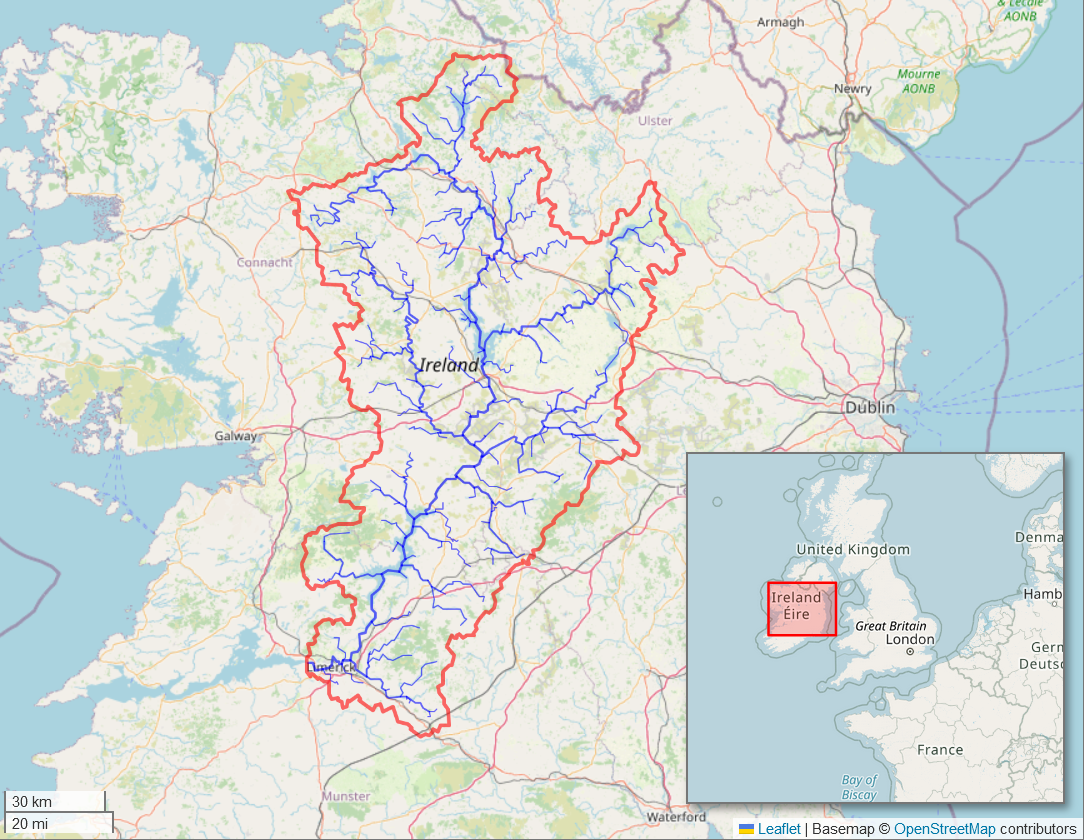
The River Shannon is Ireland's longest river. It begins in County Cavan and enters the Atlantic Ocean in County Limerick, spanning over 360 kilometers (see Figure 1). The environmental history of this expansive watershed coincides with cultural and colonial histories. Settlements along its banks date back to the Mesolithic Age, and canals carved out for trade and transport have reshaped its flows.1 Since Ireland’s partial independence after the Anglo-Irish Treaty of 1921, the lower Shannon has been a site of industrial development, from the Shannon Scheme’s building of the Ardnacrusha power station to the construction of manufacturing facilities like Aughinish Alumina, Europe’s largest bauxite refinery situated on the Shannon Estuary.
Artistic responses to industrialization on the lower River Shannon grapple with and reflect changing environments and shifting understandings of place, often using more realist aesthetics. As Sorcha O’Brien shows, Seán Keating, Brigid O’Brien, and George Atkinson tried to capture the Shannon Scheme as it happened, though “all three were working from positions which rejected avant-garde Modernist experiments current in Europe in the late 1920s,” and instead “demonstrated a consciousness of the epochal nature of the project and its importance for the positioning of the new Ireland in the modern world.” 2 In keeping with these more traditional and often realist artistic techniques, representations of the Abbey Fishermen’s struggle against the dam’s devastating impact on fish migration appear in local and family histories, like those from William Lysaght and Sharon Clancy, and in the impressionistic but still lifelike watercolors of Bobby Duhig. 3 Twenty-first century representations of development on the lower River Shannon, such as Liz Ryan’s Under Starry Skies and Michele Horrigan’s Stigma Damages , draw on photography, found objects, archival materials, and film to engage with the materiality of environments and their representations. As the Shannon Scheme artists, to use O’Brien’s words, evince “an appreciation for technique, or Technik, the way something can be created out of raw materials,” Ryan and Horrigan’s artworks become resources through which to critically reflect upon industrialization and productively reimagine more sustainable relationships to place and environment. 4
The need to balance often competing understandings of economic and environmental sustainability was popularized in the 1980s when definitions of sustainability consolidated around conversations about sustainable development. 9 The United Nations (UN), drawing on the 1987 Brundtland Commission’s Report of the World Commission on Environment and Development: Our Common Future , defines “sustainability as meeting the needs of the present without compromising the ability of future generations to meet their own needs.” 10 Yet what constitutes a need and whose needs are privileged in the present and in the future remains a topic of debate. As environmental justice scholars have long advocated, an integrated approach to social, economic, and environmental sustainability is necessary. 11 While the UN Sustainable Development Goals focus on social sustainability (including preserving cultural and natural heritage under Goal 11: Sustainable Cities and Communities ), they do not necessarily address questions of justice, particularly in postcolonial contexts. In their introduction to Sustainability: Approaches to Environmental Justice and Social Power, Julie Sze and colleagues explain that “Despite the rapid expansion of sustainability research since the turn of the twenty-first century, fundamental questions about core concepts and values of sustainability as it relates to social justice have remained largely unexplored.” 12 Bringing ideas of “social justice” to “core concepts and values of sustainability” helps to answer questions about what sustainability can mean amid the ongoing contamination in which postcolonial nations like the Republic of Ireland work to meet the needs of the national citizenry in the present and in an imagined future at the expense of many regional and more-than-human communities.
Drawing on postcolonial ecocritical, environmental justice, and ecomedia studies theory, this article examines how artistic representations of the lower River Shannon expose and rework understandings of sustainability and what those understandings might mean for Ireland more broadly today. After analyzing material environments in the content and media of Keating’s paintings of the Shannon Scheme, I examine assertions of intergenerational and multispecies sustainability in narratives of the Abbey Fishermen. The descendants of the Abbey Fishermen figure in Ryan’s 2017 book Under Starry Skies , which includes replications of Duhig’s artworks alongside photography of Moyross, a neighborhood on the outskirts of Limerick, to formally and semantically reframe ongoing and dynamic attachments to multispecies environments. These intergenerational and multispecies sustainabilities come under scrutiny in Horrigan’s multimodal Stigma Damages exhibits about the Aughinish Alumina. Horrigan’s curatorial choices and arts-based research at her 2024 exhibition at The Model in Sligo and at an exhibit she created at Tilburg University in spring 2025 demonstrate understandings of accumulation and permeability that rework the possibilities of sustainability in an increasingly toxic world. Attending to artistic engagement with the lower River Shannon over the past century amplifies narratives of shared destruction, complicity, and hope to imagine more just forms of sustainability on a shared planet.

Shannon Scheme
My analysis begins with representations of the Shannon Scheme in the paintings of Seán Keating.
Abbey Fishermen
Next, I analyze understandings of intergenerational and multispecies sustainabilities in representations of the Abbey Fishermen, who protested the Shannon Scheme.
Moyross
The descendants of the Abbey Fishermen implicitly figure in Liz Ryan's 2017 photography of Moyross, just outside of Limerick, which I subsequently explore.
Aughinish Alumina
Finally, this article offers an analysis of Michele Horrigan's multimodal Stigma Damages exhibits about the Aughinish Alumina bauxite refinery on the Shannon Estuary.
Naturalizing Modernization
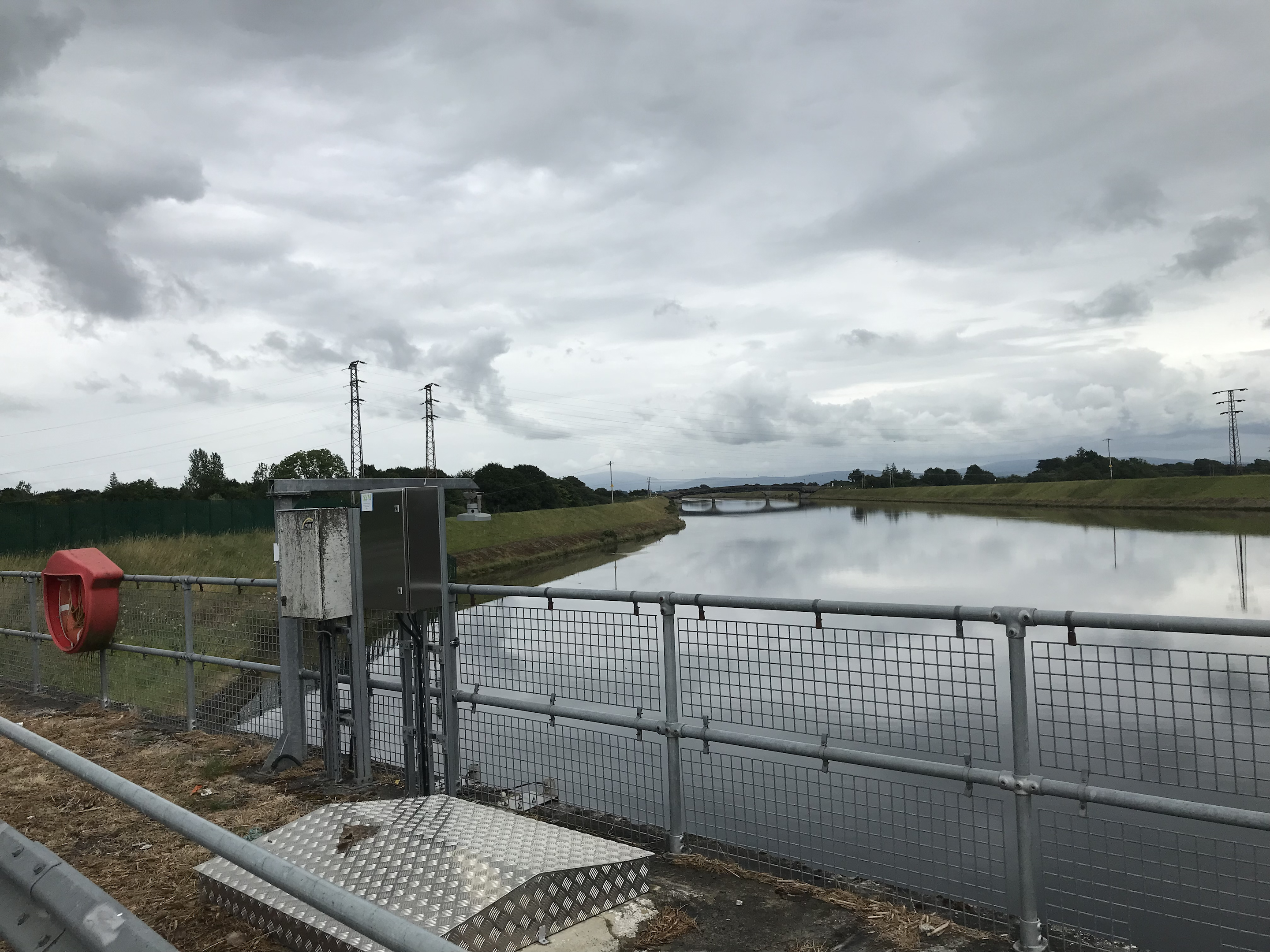
Hydropower has historically been seen as a relatively clean and environmentally sustainable form of energy despite its devastating effects on riparian ecosystems and cultures. 13 In the aftermath of the War of Independence (1919-1921) and the Civil War (1922-1923) and amid ongoing economic uncertainty, building a hydroelectric dam on the River Shannon asserted progress for the new nation. In 1925, the Free State government, led by Cumann na nGaedheal under William Cosgrave, approved the Shannon Scheme, a project that would collaborate with the German Siemens Schuckert company to build one of the first national electricity grids and the then largest hydroelectric dam in Europe on the River Shannon at what became Ardnacrusha in County Limerick. 14 The Shannon Scheme emerged as a way the postcolonial nation could reclaim sovereignty and industrialize the colonially underdeveloped state while advancing understandings of Irishness as technologically and scientifically modern. 15 Besides countering colonial stereotypes, the Shannon Scheme also distanced itself from English economic and political hegemony by establishing a collaboration between the Free State and a German company in the aftermath of WWI. The Shannon Scheme helped to establish the Electricity Supply Board (ESB) in 1927, but it also drastically changed the environment and damaged riparian ecosystems as it claimed lands and livelihoods of many locals. 16
The damage wrought on material environments to advance electrification contrasted sharply with the deployment of environmental destruction as a wartime tactic less than a decade earlier, and Keating sought to document these more productive changes to landscapes and waterways of rural Ireland. 17 Hailing from Limerick and training as an artist in Dublin with William Orpen before eventually becoming president of the Royal Hibernian Academy, Keating took time off teaching at the Dublin Metropolitan School of Art to document the Shannon Scheme construction between 1926 and 1927. 18 Scholars have widely discussed Keating’s Shannon Scheme paintings, especially his 1929 allegorical painting, Night’s Candles are Burnt Out, which features the Ardnacrusha dam in the background. According to Keating, the painting “depicts the transition of Ireland from a country of ancient stagnation to a state of freedom and progress.” 19 Keating’s description of his famous painting attests to his conviction that modernization was necessary for the new nation in the aftermath of war. 20
While Keating’s paintings draw on naturalist and realist aesthetics that evince his artistic refusal of more experimental forms, Éimear O’Connor’s extensive analyses of Keating’s life and work demonstrate that this aesthetic choice was not a conservative attachment to the past but an intentional decision about how to intervene in debates about Irish art and modernity in the 1920s and 30s. O'Connor writes: “Rather, the polemic situation in evidence at the time now serves to highlight a tension between tradition and modernity, which was ultimately necessary for progress to happen in the first instance. It is now clear that Keating was in fact, acutely aware of this fact.” 21 The traditional techniques Keating deploys strategically engage with the modernization his Shannon Scheme paintings depict. They do so, as O’Connor shows, by also at times integrating modernist aesthetics, such as Constructivist and Futurist aesthetics. 22 A closer examination of Keating’s paintings demonstrates how his use of more traditional techniques is not antithetical to modernity but is rather an integral part of modernization.
Bringing ecocritical lenses to Keating’s paintings reveals ongoing negotiations between people and material environments that undergird understandings of both tradition and modernity in the postcolonial Free State. Tensions between tradition and modernity correspond to tensions between nature and culture in Keating’s paintings of the construction of the headrace. The headrace construction entailed digging a twelve-kilometer-long channel from Lough Derg to the power station at Ardnacrusha, which would create the height necessary for the water to fall onto turbines to generate electricity. 23 Although Keating was not commissioned by the ESB, scholars like O’Connor, O’Brien, and Michael Rubenstein have shown how Keating’s paintings of the Shannon Scheme construction align with the ESB’s more propagandistic depictions of the project. 24 These positive reflections of the project indicate national pride in sustaining the state’s newly acquired sovereignty and expanding its technologies and economy. Keating’s paintings also document the machinery used to build the canals and dam. Through these depictions, Keating’s headrace paintings reveal ongoing relationships between the terrestrial and watery materials at the construction site in the media and cyclical compositional components of the paintings. These relationships to material environments show, in the words of Jason Moore, how “[h]uman agency is always within, and dialectically bound to, nature as a whole.” 25 Attending to environmental relationships in Keating’s work challenges ideologies in which, to quote Carolyn Merchant, “ideas…of mechanism and of the domination and mastery of nature…became core concepts of the modern world.” 26 By showing machinery and changing material environments using traditional art materials and techniques, Keating's paintings acknowledge existing relationships with more-than-human agencies through which they try to reconcile divisions between tradition and modernity and naturalize processes of modernization.
Figure 2: Luffelbagger at Work with Stone Wagon in Foreground
While developing Ireland’s resources and, to quote Patrick Pearse, “harness the rivers,” was an integral ideology of national independence, 27 Keating’s headrace paintings indicate cyclical rather than linear progress narratives that recognize more-than-human interdependencies while naturalizing the building of the canal. This comes into sharp relief in Luffelbagger at Work with Stone Wagon in Foreground (see Figure 2), which centers a barren mound of recently displaced earth that will become the side of the headrace canal. Despite the activity on the periphery of the painting, the portrayal of this mound creates a relatively blank canvas around which everything else circulates. This framing of the canal wall positions the land as a tabula rasa that will build and sustain the new nation.
Tracing the edges of the central mound of earth in the painting reveals a cycle of development that refuses clear divisions between culture and nature, state building and material environments, or tradition and modernity. Rather, the technologies, people, and land interact to construct the canal. The luffelbagger’s arm extends to a pile of debris on the lower right. As the debris pile descends, a small trail ascends to a worker who kneels in some kind of labor behind others who disappear at the edge of the painting. Just above the workers, a train of rail cars appears from beyond the frame and leads the viewer's gaze in a straight line back to the luffelbagger. This visual transition from man to machine encircles the blank hillside. Like the viewer of the painting, an overseer in the lower right observes this cycle of work.
Cyclical interactions among people, machines, and material environments are emphasized through the tempura medium of the painting. Keating worked with tempura, oil, and gouache paints, all of which require extracting and concentrating pigments from plants and rocks. These pigments originate from various locations around the world and are often mixed with other materials, such as gum from a variety of trees, honey, linseed oil, egg, and other materials to make paints. 28 When mixed with water, tempura paints produce multiple colors as lines blur and flow over each other. The painting’s medium formally reflects the cycles of human labor, machine power, more-than-human agencies, and material environments that Keating depicts. The flowing and dripping strokes in this painting capture the material agencies that pushed back on but also enabled the Shannon Scheme and Keating’s paintings of it. In both its content and medium, the mound of earth around which everything else in the painting circulates is, to use posthumanism ecocritical scholar Stacy Alaimo’s words, “a materiality that is never an external, blank or inert space but the active emergent substance of ourselves and others.” 29 Together, Keating, the tempura, water, and canvas become co-creators in depictions of the construction, which itself requires similar collaborations among people, machines, and material and multispecies environments.

Keating’s depictions of the headrace construction document people and place to renegotiate relationships between tradition and modernity and to naturalize modernization, even as the dam’s development rapidly altered relationships to land. These changes came as trade unions failed to secure a living wage for laborers and as certain groups, such as the Abbey Fishermen and the fish upon which they depended, were culturally, economically, and ecologically subjugated by the project. 37 Indeed, many lost their land and homes during the construction of the headrace and tailrace, with people such as Patrick McCormick and Patrick Boyle resisting removal and the proposed compensation. 38 Michael McCarthy describes those dispossessed by the project as “casualties of progress.” 39 Such understandings of progress promote state and economic sustainability “to meet the needs of the present” of an imagined national citizenry that overwhelms and incorporates regional communities. 40 In documenting the construction of the headrace, Keating's paintings reveal understandings of state and economic sustainability for the nation as they also bear witness to relationships to land and water that materially enable but are all too often discursively erased by Western forms of development.
Resisting Erasure
Despite the numerous newspaper articles written by and about the Abbey Fishermen in the 1930s, ecocritical scholars have yet to examine how this history might inform studies of sustainability in Ireland today. A group of net fishers who had fished the waters of the Shannon near Limerick for generations became known as the Abbey Fishermen, according to local historian William Lysaght, when the 1903 Land Act “gave landowners, whose lands touched the river, riparian rights (the ownership of the fishing rights to the centre of the river from a particular bank). The Act prompted the Abbey fishermen to unite and form an organised society, for the reason that they feared that the fisheries which they had hitherto enjoyed might be taken from them.” 41 Shared experiences of oppression consolidated the group, and collective action emerged as the fishers’ relatively sustainable way of life came under threat. While their struggle may have begun decades earlier, the Abbey Fishermen are perhaps most well known for having unsuccessfully but tenaciously protested the negative impact that the Shannon Scheme had on the local fisheries. During their famous protest, the Battle of the Tailrace, the Abbey Fishermen launched their boats in July of 1932 to catch salmon in the dam’s tailrace, where the water flowed out of the turbines. Violence erupted between the fishers and the police, which Peadar O’Donnell describes in An Phoblacht: “Just picture it: two powerful motor boats full of well-coated bailiffs wait while frail two-men shells of boats go quickly into the tail race…The scene suddenly becomes sickening…there is a stampede: military with fixed bayonets are clearing the embankment: police are using batons.” 42 Despite state oppression of the protest, the fishers continued to resist government policies as they were pushed into negotiations with the ESB about compensation for the loss of their livelihoods after the Shannon Fisheries Act passed in 1935.
The marginalization of these local fishers paradoxically favored modernization while the Free State government shifted towards more protectionist economies and attempts to revive traditional ways of life after Fianna Fáil came to power in 1932. While Colin Graham describes the Abbey Fishermen as “performatively subaltern,” 43 Mark Maguire’s analysis shows how the government drew on national symbols through which “[t]he fishermen’s culture was mapped, museumised, surveyed, and classified. The nation did not tolerate their marginal borderland.” 44 Maguire concludes that “[t]he state sought to destroy the very kind of group which its nationalist rhetoric celebrated, and did so in the name of the nation.” 45 While histories of the Shannon Scheme often include references to the Abbey Fishermen, Lysaght’s 1965 The Abbey Fishermen: A Short History and Sharon Clancy’s 2006 The Abbey Fishermen: History and Culture of a Fishing Community are two of the few works dedicated to their story. Lysaght’s history was written in mid-century Ireland, as modernization schemes intensified through foreign direct investment (FDI) facilitated by Taoiseach Seán Lemass, who had been the Minister of Industry and Commerce during the Abbey Fishermen’s protests in the mid-1930s. Building on Lysaght, Clancy documents the Abbey Fishermen seventy-six years after the opening of the Ardnacrusha dam as fish continue to struggle to survive amid intensifying environmental pressures. 46 Both Lysaght and Clancy describe the history and culture of the net fishing community in Limerick, which existed in the region since, in Lysaght’s words, “time immemorial” and which divided the river into allocated fishing regions through practices that “must surely be a unique survival of the principles of Brehon Law.” 47 This framing of the Abbey Fishermen establishes their indigeneity as it reveals enduring practices that policymakers today must concede are more sustainable than the Shannon Scheme ultimately proved to be.
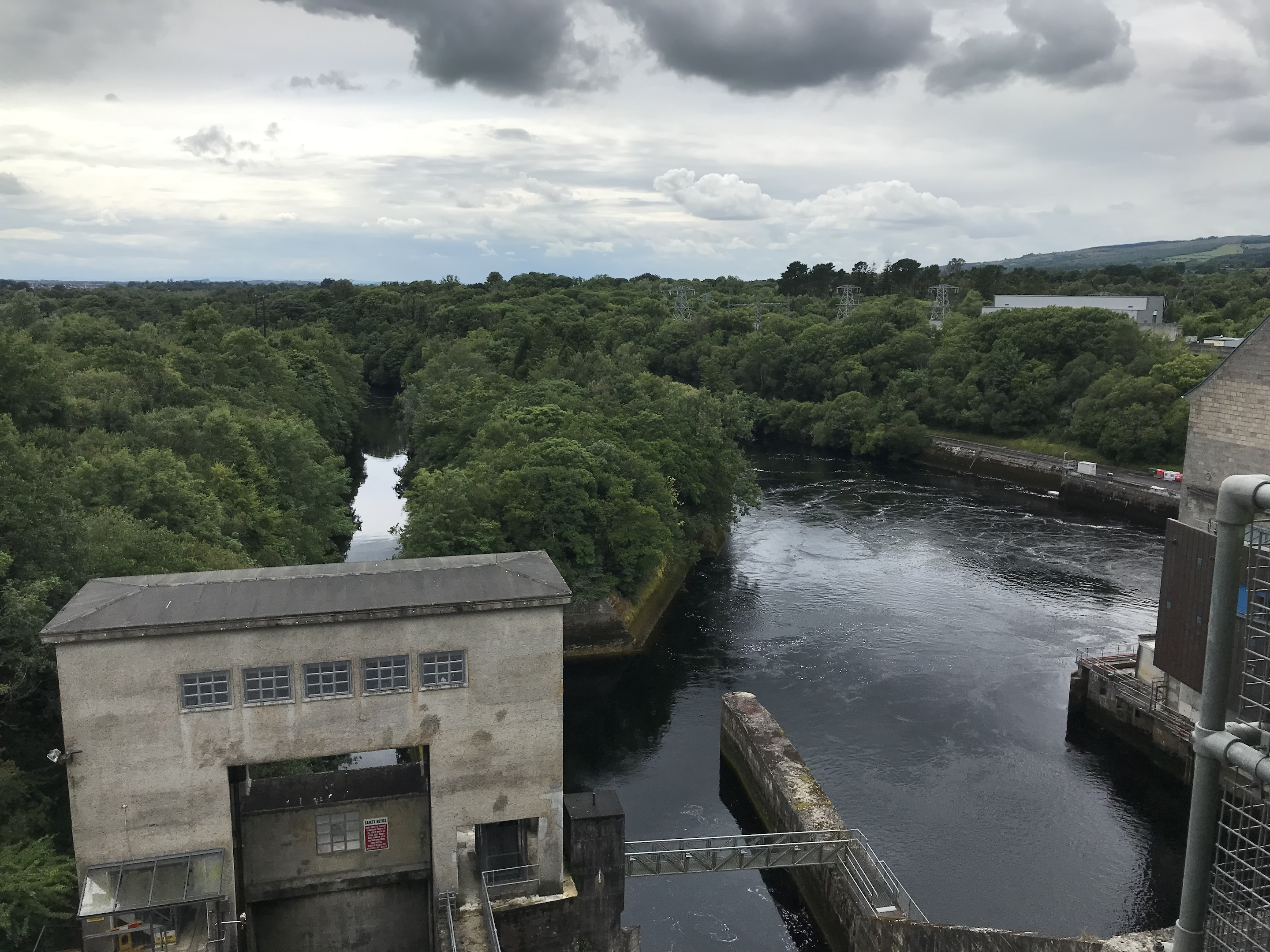
The Abbey Fishermen’s struggle reveals ways of life that depend on intergenerational and multispecies relationships. The debates leading up to the passing of the Shannon Fisheries Act and the ESB’s ability to legally purchase the fishing rights to parts of the River Shannon demonstrates tensions between the state’s push to industrialize domestically and the fish and fishers’ efforts to survive and maintain their ways of life. The Abbey Fishermen relied on fish migration routes and fish lifecycles that the dam violently interrupted. Clancy points out that the turbines increased “the speed of water coming out of the tail race [which] confused the salmon and eels” and they “instinctively swam into the fast flowing water, instead of following the natural course of the Shannon.” 48 While some migrating fish were trapped upstream of the power station in the headrace, others encountered electrified chains strung across the entrance to the tailrace. The chains were meant to deter the fish swimming into the tailrace and encountering the turbines, but instead, they killed hundreds of salmon in a single day, as Lysaght explains: “The Abbey fishermen were greatly perturbed by all this wanton slaughter of salmon and they were determined that it must stop.” 49 The electrified chains were disbanded, to use Lysaght’s words, “[a]fter some hundreds of fish had been killed in one day,” but the fishers continued to protest the ongoing destruction of the salmon migration routes, which undermined the ability of the fish and the fishers to exist in the Free State.
The struggle of the Abbey Fishermen against the Shannon Scheme foregrounds marginalized but existent understandings of multispecies sustainability. In the fishers’ published response in the Limerick Leader on 18 November 1936 to proposed compensation from the ESB, they were thinking about their livelihood and that of their children, not of a one-time payout, as Secretary of the Abbey Fishermen Guild, Michael Hayes, writes: “To have the respect of the people laws must be founded on the bedrock of moral right. We fishermen honestly believe that this Fishery Act is entirely contrary to this acknowledged principle, for not alone will it deprive us of our way of living, which is all we have, but it also deprives generations of our children to come.” 50 This statement asserts how ways of life and livelihoods across generations and species are a “moral right,” as the fishers cannot exist without the migrating fish.
Instead of approaching the river through intergenerational and multispecies interdependencies, the state and the ESB sought to separately manage diverse populations. Under the 1935 Shannon Fisheries Act, the fishers were to be compensated, and the fish were reified into economic systems as a natural resource. The Act allowed the ESB to purchase fishing rights, giving them “the duty of managing, conducting and preserving the Shannon Fisheries.” 51 The ESB subsequently purchased multiple fishing rights, limited the allowed catch, and banned net fishing to “increas[e] the very depleted stock of fish” and to “concentrat[e] on the development of the fisheries with a view to future revenue.” 52 This focus on “future revenue” indicates management policies that today would be called “maximum sustainable yield,” which Callum Roberts explains, “is one of the products of single-species fishery models. These models assume that equilibrium can be reached between the amount of fishing mortality and the growth rate of a fish population…In the real world, there is no such thing as a fixed maximum sustainable yield to target.” 53 In contrast to the fishers’ enduring relationship with the fish, which sustained a centuries-old way of life, the state sought to extract value from the fish as it also extracted energy from the river through managing imagined sustainable yields of both depleted fish populations and water during drought, such as in the winter of 1932. 54
Extractive understandings of sustainability indicate how “meeting the needs of the present without compromising the ability of future generations to meet their own needs” retains a focus on particular human communities in the nation at the expense of regional others. 55 Although the fish were eventually given ladders and hatcheries, they continue to struggle to survive. 56 The Abbey Fishermen, as Lysaght concludes, “have been absorbed by less colourful, less fruitful employment—salute them, their heritage was sacrificed on the altar of progress.”57 Sustaining the nation and its economy through forms of industrialization led to the marginalization and erasure of human and more-than-human communities. Yet the histories of the Abbey Fishermen and their struggle bear witness to human and more-than-human lifeways that demonstrate an economically, ecologically, and socially integrated and intergenerational understanding of sustainability.
Reclaiming Land and History
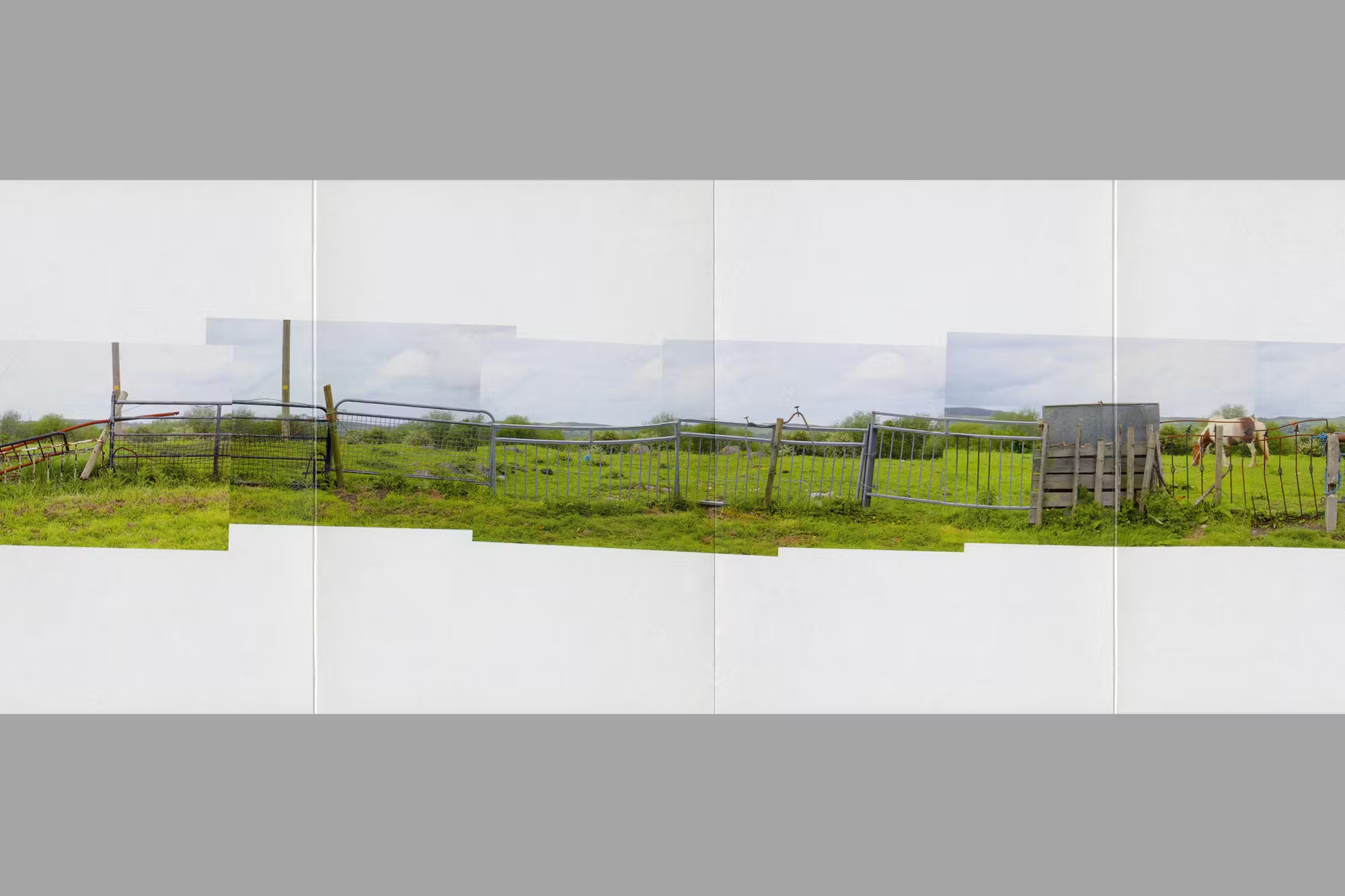
The Abbey Fishermen’s intergenerational and multispecies understandings of sustainability find an echo in Liz Ryan’s 2017 book, Under Starry Skies , a 3x5 inch book (see Figure 8). The accordion-fold book expands to present a panorama of photographs documenting a makeshift fence along a field in Moyross, a social housing project developed on the north side of Limerick city in the 1970s, which sought to address an ongoing housing crisis. 58 The fence comprises various objects tied together or placed adjacently to establish a barrier between the road and the field where locals graze their horses. As Askeaton Contemporary Arts (ACA) director Michele Horrigan describes in the introduction to Ryan’s book, the fence is “the reclamation by horse owners of land from a half-baked bureaucratic imposition[, which] declares the field as outside the limits of governance.” 59 In refusing the Industrial Development Agency’s (IDA) legal claim to the field, the fence that Ryan visually registers rejects the social exclusion and displacement of the local community to further national needs and interests. Scholars such as Niamh Hourigan, Eoin Devereux, Amanda Haynes, Martin J. Power, and Cliona Barnes, among others, have documented how socio-economic oppression in and media representations of Moyross have contributed to stigmatization and social exclusion. 60 Ryan’s Under Starry Skies counters this stigmatization and exclusion by showing how the horse owners invert and rework cultural meanings of fences to, in Horrigan’s words, “embrac[e] [...] the very periphery and edge of space they were marginalized to in the 1970s and 80s.” 61 Using ecocritical theories to examine the materiality and content of Ryan’s book demonstrates how Under Starry Skies amplifies the community’s use of the fence to reclaim the land and challenge ongoing histories of colonial and neocolonial extraction that render land into real estate.
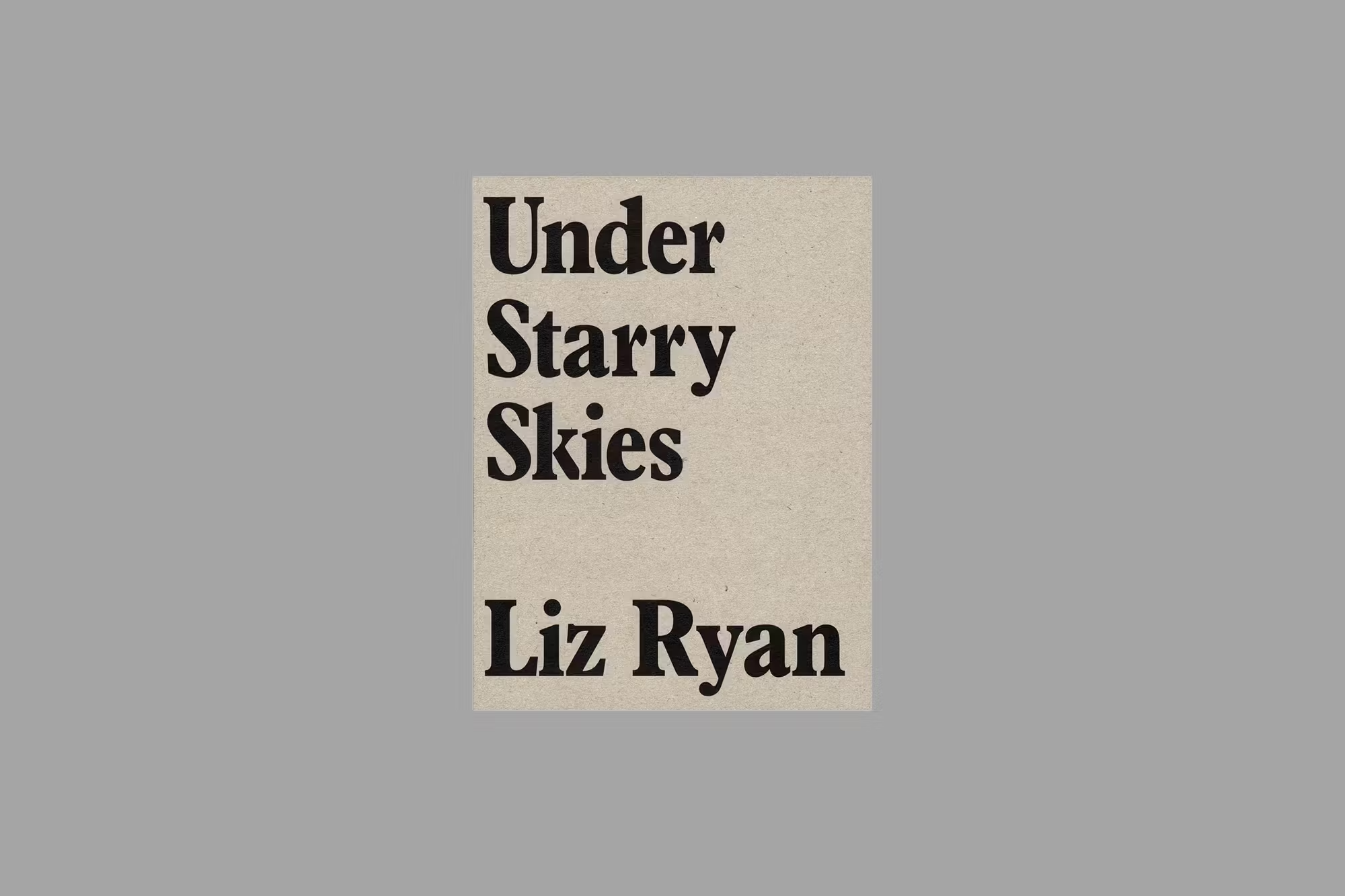
Fences often delineate property ownership and consequently play an ongoing role in the reification of multispecies environments into natural resources for globalized economies. In contrast to these normative and appropriative uses of fences, the fence in Moyross challenges the IDA’s claims to ownership. It reveals an instance of what Patrick Bresnihan defines as “commoning,” which “denotes the continuous making and remaking of the commons, which starts with the immediate and intimate understanding that the world is already shared.” 62 This paradoxical role of the fence in Moyross and in its depiction in Under Starry Skies arises in the intertextual references to the American folk song, “Don’t Fence Me In,” originally popularized by Cole Porter in the 1930s but reproduced since by numerous musicians. The song’s title originated from the poem, “Open Range,” by miner and surveyor Robert Fletcher, who facilitated the expansion of tourism through highways and road markers across the US state of Montana. 63 The first page of Ryan’s book quotes the song: “Oh, give me land, lots of land under starry skies above – don’t fence me in.” 64 The calls for open spaces free of territorial barriers in both the poem and the song reflect the ideologies of Manifest Destiny that were used to justify the ongoing genocide of Indigenous peoples whose homelands occupy the “open range” and "open country" to which Fletcher and Porter refer. In contrast to the colonial connotations of the song, Under Starry Skies reflects how Irish culture often invokes American Western references, which, to quote Elizabeth Butler Cullingford, “us[e] the cowboy metaphor to indict the indifference or hostility of the Southern state towards a marginalized sector of its own population.” 65 The title’s intertextual reference to a song connotes the ongoing marginalization and erasure of existing relationships between people and place in Moyross.
Under Starry Skies raises questions about how understandings of territory and sovereignty for the good of the nation are entangled with the erasure of numerous peoples and places whose lives and lifeways are positioned outside the colonial and neocolonial logics of property ownership. Like the fence, Ryan’s unfolded book reclaims and reworks space concealed when the book is in its folded form, thereby indicating an expansive, colorful, and dynamic cultural expression often marginalized by Western forms of development. This concealment indexically points to the visual erasure of Moyross that scholars have documented; Power and colleagues analyze, for instance, how “concerns regarding the initial omission of Moyross from [Google] Street View reflect experiences of exclusion” and perpetuate media stigmatization and objectification as a place to look at from the outside. 66 Rather than looking “over the wall” into Moyross, Under Starry Skies allows Moyross to unfold in the numerous localities and spaces to which the book has found its way. When fully open, the arrangement of the photographs ensures the continuity of fence across time and space.
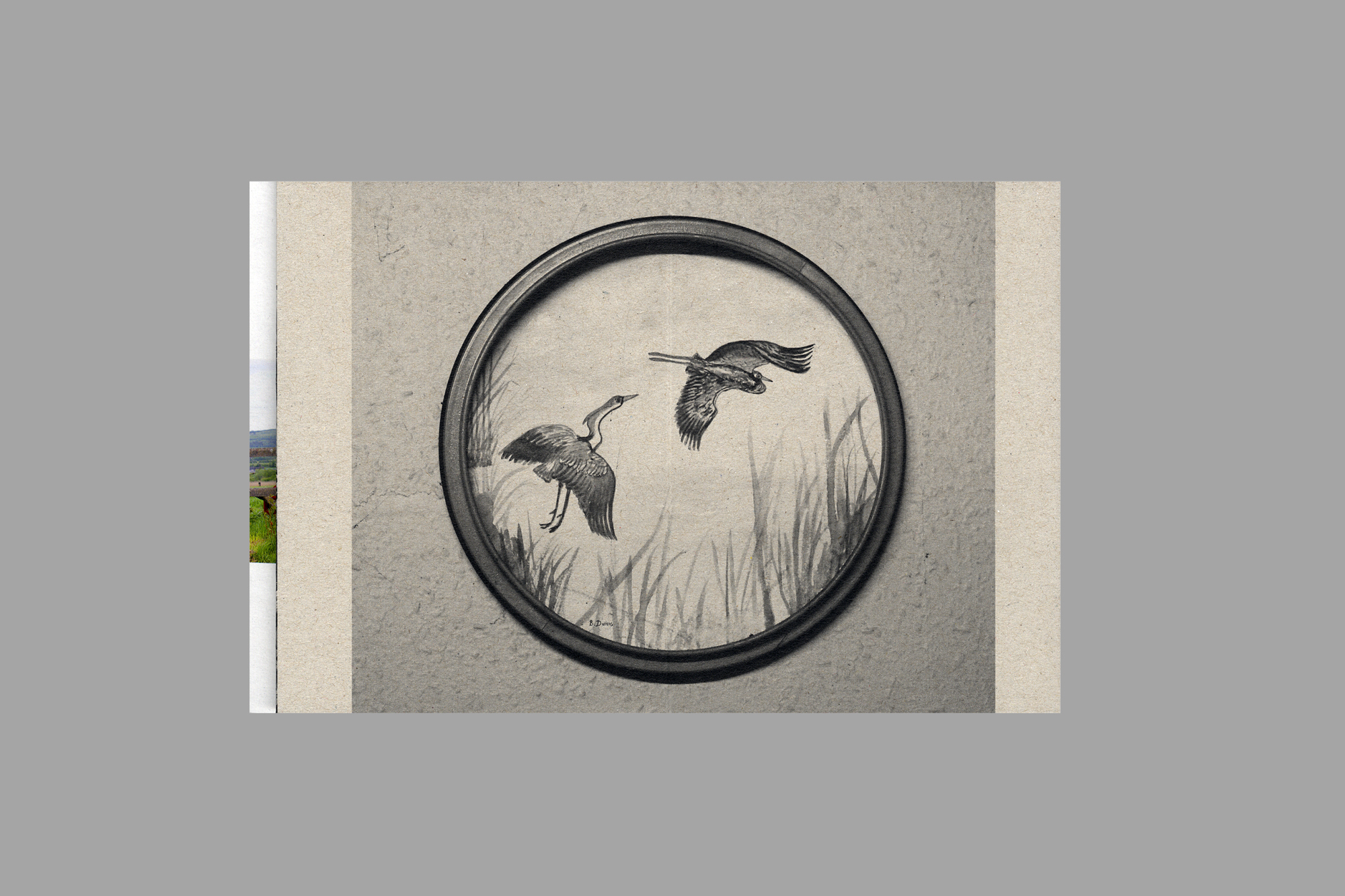
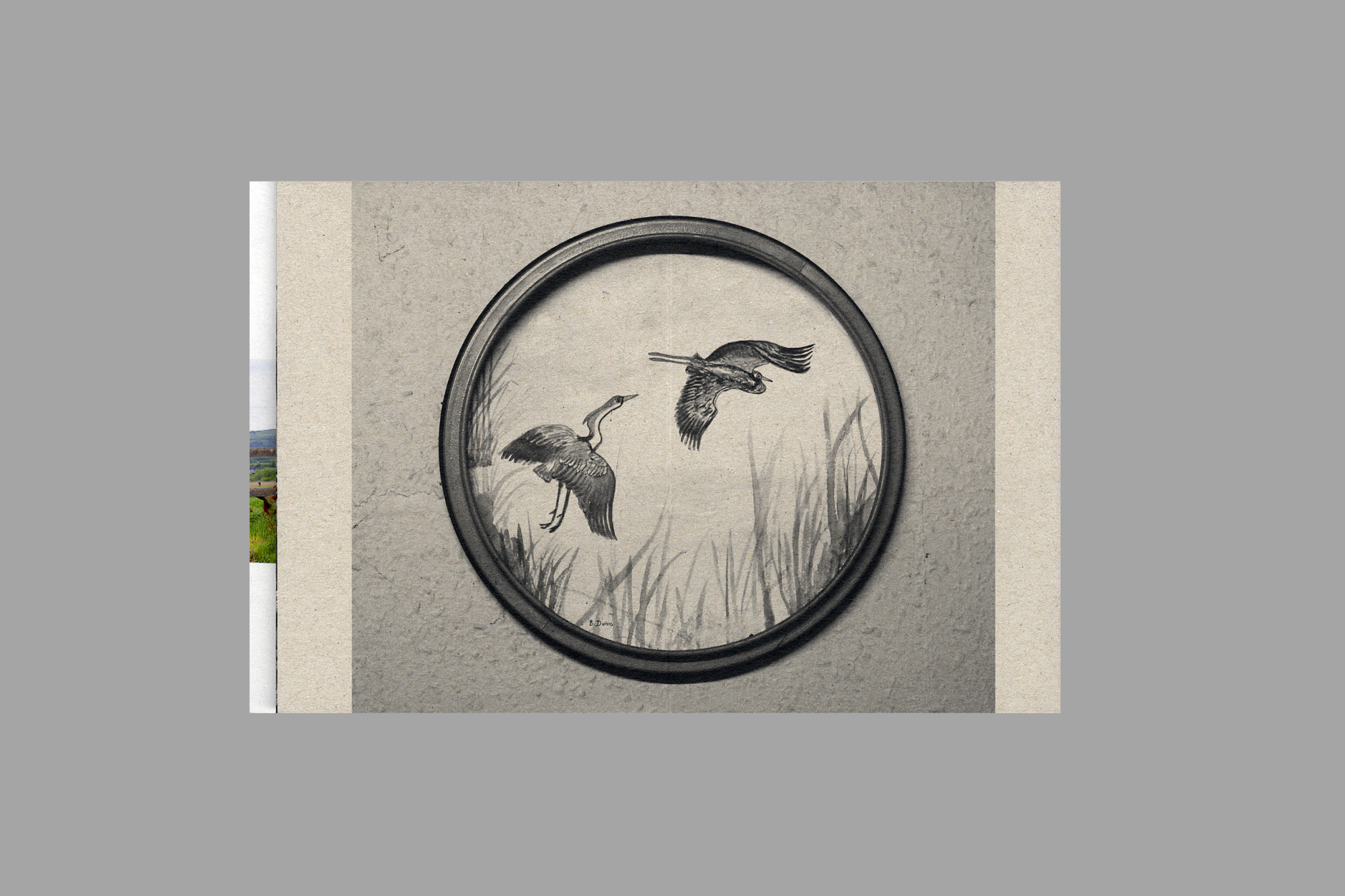
The unbleached brown cardstock and sepia tones of the book’s cover and introductory materials contrast with the twenty-eight glossy color photos of the fence on the reverse side of Under Starry Skies, thereby recalling tendencies also in Keating’s work to integrate traditional and modern artistic techniques. By including reproductions of artworks by Duhig (see Figure 9), an artist known for documenting the Abbey Fishermen and their legacy, 67 in the introductory materials, Ryan’s book comments on the environmental impacts of industry and urbanization in the ongoing marginalization of communities, both human and more-than-human. A reproduced watercolor of ducks in a wetland of the River Shannon is framed, Horrigan explains, by a clay sewage pipe. 68 This frame indicates the materials from which the city’s infrastructure is made in addition to the sewage runoff that permeates the riparian environment. The circular frame, like the cyclical elements in some of Keating’s Shannon Scheme paintings, emphasizes the inextricable entanglement of human and more-than-human environments. This point materially manifests not only in the frame but also in the watercolor medium of the painting, where the liquid used to make the painting comes from the very environment the painting depicts. Like many of Keating's paintings of the headrace construction, Duhig’s painting materially and semantically bears witness to the ongoing relationships between people and environment that persist in Ryan’s book.
The form and content of Under Starry Skies foreground how photography’s role in preserving the past materially and culturally informs understandings of and attachments to place in the future, thereby indicating whose needs matter in the present and for future generations. While the nearly two-meter-long unfolded book gives a continuous view of the fence (see Figure 10), the edges of the photographs are visible, and the book’s folds dissect several of these photos. The panorama of seemingly separate photographs invokes the materiality of analogue photography and its implicit claims to authenticity. Photography historically has been seen as a transparent window to reality, supposedly documenting truth through capturing a moment on film. 69 Yet these seemingly objective visual depictions of the world emerge in lockstep with ongoing histories of colonial expansion and extraction. Photography historically promoted modernization through geologic surveying in Ireland and elsewhere. 70 Indeed, geologic survey photographs facilitated the extraction of silver necessary for producing photographs historically and of the rare earth minerals required for digital photography today. 71 The history of photography cultivates what Siobhan Angus describes as the “extractive gaze,” which is “a way of seeing the world [that] recasts environmental degradation as progress under the guise of technological innovation.” 72 Coopting and reworking this “extractive gaze” in which the history of photography is implicated, Ryan’s photographs offer a different view by framing the past in material photographs to construct meaning about what has been for the future.
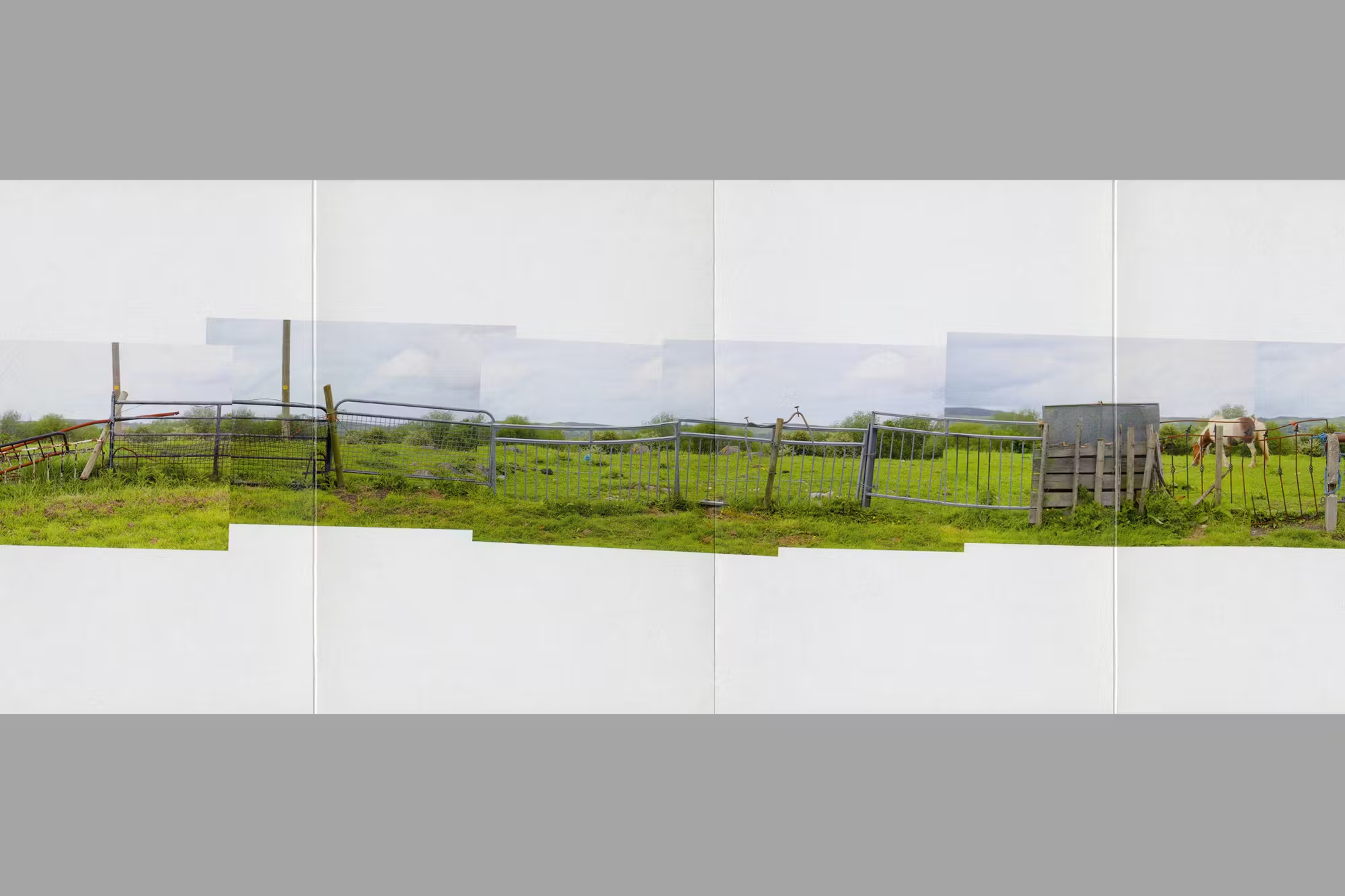
While the fence asserts a claim to the IDA’s field, Ryan’s physical book and its content make a material and cultural claim on Moyross’s environmental past, present, and future to reveal a continuity of multispecies communities in specific attachments to place. Maintaining the fence across the panorama exposes a broken landscape where hills and trees abruptly end. This ruptured depiction of the environment indicates a fractured landscape after enclosure and the extraction and commodification of multispecies environments. The continuity of the fence is interrupted, however, where a lone horse appears in the field. The arrangement of the photographs maintains the integrity of the horse at the expense of the fence in this part of the panorama. The coherence of the horse emphasizes the ongoing relationship between local human communities and their equestrian companions in addition to the horse’s relationship with the field. The focus on the horse combines with the book’s intertextual reference to the lyrics of “Don’t Fence Me In,” which reference the singer's “Cayuse” horse. This line metonymically registers the erasure of the Cayuse Indigenous peoples, who today are part of the Confederated Tribes of Umatilla Indian Reservation and known for their horsemanship. 73 The visual focus on the horse documents the marginalization of multiple communities through the expansion of state territory, both in the US west but also in Ireland by the IDA and state-sanctioned industries.
By physically reclaiming space and time in its depiction of Moyross, Ryan’s book culturally sustains multispecies and intergenerational collaborations whose histories intersect with the IDA field. While private property and industrial development is often justified for the common good, claims to a common national good regularly undermine intergenerational and multispecies sustainabilities. Intergenerational sustainability is necessary, however, to use Hannah Arendt's words, for a “common world,” which “cannot be erected for one generation and planned for the living only; it must transcend the life-span of mortal men. Without this transcendence into a potential earthly immortality, no politics, strictly speaking, no common world and no public realm, is possible.” 74 Through challenging the sacrifice of certain communities to “meet the needs of the present without compromising the ability of future generations to meet their own needs,” Under Starry Skies documents the aftermath of the Shannon Scheme and raises questions about how forms of development on the Shannon Estuary unevenly distribute the harms and benefits of industrialization and multinational FDI in Ireland. 75
Europe's Sacrifice Zone
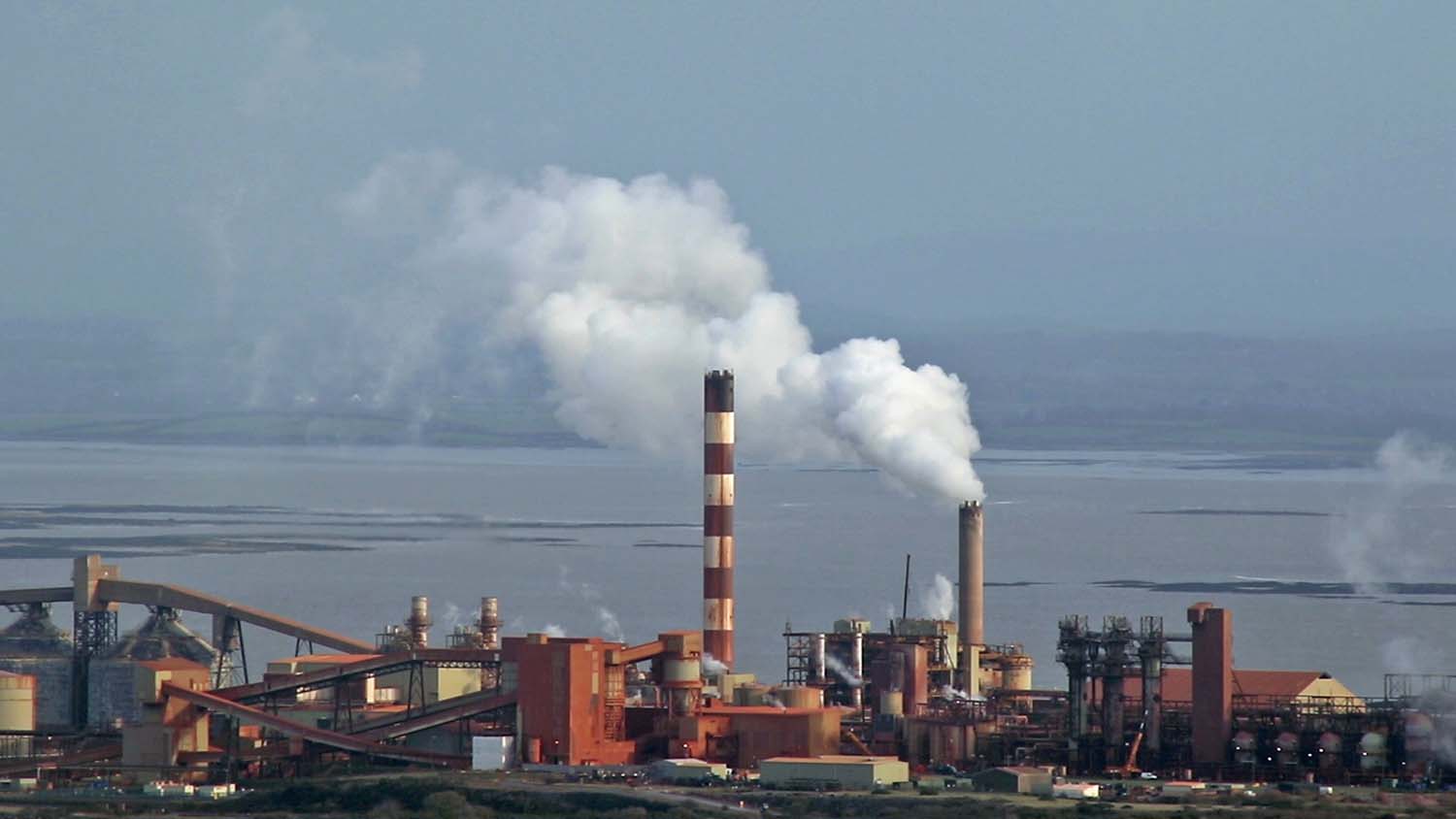
The uneven division of the benefits and burdens of modernization in Ireland are clearly visible in communities’ ongoing struggles for clean environments. Rural communities in Ireland fighting for environmentally sustainable industries have regularly been depicted as against progress and development, as a conflict between tradition and modernity, rather than as environmental justice struggles contesting what progress and sustainability could and should mean. 76 Divisions between social and environmental issues emerged alongside class hierarchies and urban-rural divides in mainstream environmental movements in Ireland as Europe’s largest bauxite refinery, Aughinish Alumina opened in Askeaton, Co. Limerick, in 1983 (see Figure 11). 77 Initially created by the Canadian Alcan, Aughinish Alumina is now owned by Rusal, a Russian-owned company, with known connections to the Russian government and military. 78 Like bauxite refineries around the world, Aughinish Alumina processes bauxite rocks into alumina power that smelters need to make a variety of aluminum products, from canned food and beverage containers to airplanes, weapons, and electronics. This process releases sulfur dioxide emissions and produces an industrial waste byproduct comprising a very fine red dust that is dangerous to breathe and that corrodes materials like rubber and car paint. 79 To prevent the dust from blowing around, Aughinish Alumina continuously sprays it with water, creating an expanding mound of red mud beside the refinery, just meters from the Shannon Estuary and atop porous limestone. The pollution produced by the refinery spreads across a region rich in biodiversity, down river from the Wyeth Nutritionals baby formula factory, and surrounded by cooperative Golden Vale dairy farms. 80
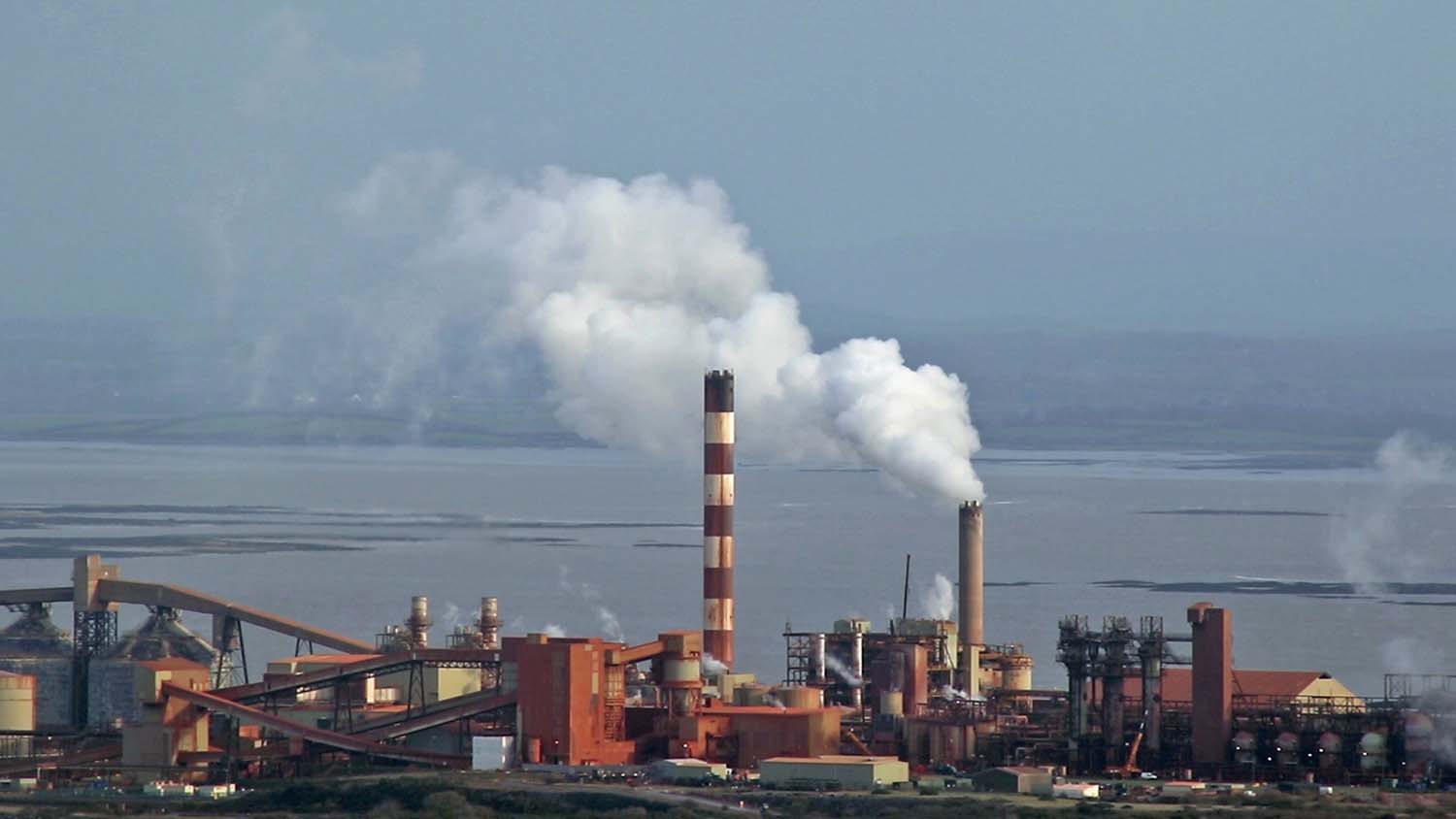
Since 2011, Askeaton artist Michele Horrigan has used arts-based research to engage with questions of justice and sustainability in her ongoing Stigma Damages project, which uses archival materials, found objects, and audiovisual installations to communicate the ongoing environmental injustices in the region. Horrigan’s personal website summarizes iterations of Stigma Damages in 2011, 2020, 2021, and 2024. In the fall of 2024, Horrigan launched the Stigma Damages website with a podcast series, forthcoming augmented reality app, and multiple resources from past and ongoing exhibitions. As Horrigan explains on the website, “stigma damages” refers to “a legal term to describe suspected environmental contamination.” 81 This term indicates the pervasive challenges environmental justice movements face globally to legally and scientifically prove correlation or even causality between exposure and health impacts, particularly when exposure to toxins emerge across multiple generations. 82 In the first podcast episode , Horrigan interviews Australian environmental justice activist Vince Puccio, who has campaigned against the Alcoa bauxite mine and refinery in Pinjarra for decades. Although researchers, such as those in the 2020 Horizon Europe project, RemovAL , are trying to make this toxic byproduct viable or at least less harmful, Puccio asserts that regardless of what the company does now “that land [where the red mud flats are] can’t be used for the next thousand years” because “there’s not a process to date that can clean up that toxic waste. Everything they have tried has failed.” 83 These conditions complicate conversations of sustainability, as the ongoing production of industrial waste is fundamentally unsustainable for social and environmental wellbeing regardless of how economically valuable aluminum might be. Technocratic solutions might imagine possibilities for how the waste could be cleaned up or repurposed in the future, but to use the words of environmental justice scholars Sze and colleagues, “many who inhabit a ‘sustainability’ space exist in a discursive and political fantasyland of ‘solutions’ (primarily, but not only, technological).” 84 In reality, on the edge of the Atlantic, the red mud flats are vulnerable to spreading into water systems and blowing through the air as the climate crisis raises sea-level and intensifies weather systems, to which the 2025 Storm Éowyn attests.
Examining Horrigan’s artworks and curatorial choices in two Stigma Damages exhibitions, one at The Model in Sligo and one at my own institution, Tilburg University , revises and expands scholarly understandings of sustainability amid persistent pollutants and intergenerational harm. Horrigan’s work is explicit in its exposure of the refinery’s destruction of the material environment, thereby reflecting, as Thomas J. Barone and Elliot W.W. Eisner define arts-based research, “an effort to extend beyond the limiting constraints of discursive communication in order to express meanings that otherwise would be ineffable.” 85 The intense scale of the environmental injustices taking place in the Askeaton region push the boundaries of “meanings that otherwise would be ineffable.” While a general explanatory note contextualizes Stigma Damages exhibits, the materials on display must speak for themselves. The various advertisements, news clippings, posters, work vests, nature signs, drawings, and photographs of Stigma Damages present a kaleidoscope of information that thematically relates to each other but does not present a single narrative. Rather, Horrigan’s project and its curation implicate the viewer in constructing a narrative about the refinery and the region across intergenerational and multispecies commitments to place, thereby emphasizing how we collectively produce and inhabit an increasingly contaminated world.
The five-room exhibit at The Model presents three video installations, a room containing archival materials and found objects, and an installation of bauxite rocks on a projector exposing intergenerational harm. All the objects and materials in the main room hang on the wall or are pinned to corkboard. Upon entering the largest room of the exhibit, the viewer encounters industry commissioned artworks representing the refinery in peaceful cohabitation with local ecosystems (see Figure 13). These artworks frame a newspaper clipping in the Weekly Observer, a local newspaper in County Limerick not widely available outside the region. The clipping notified the community of the refinery’s 2023 application to dredge and dump in sensitive riparian and marine ecosystems. This curation presents the museum goer with competing narratives. The dredged material, if the application goes through, would sustain the refinery’s dock where bauxite arrives and alumina powder is shipped to smelters abroad to make everything from tin foil and food containers to Internet cabling, planes, trains, bicycles, and even bombs. But the dredged material would be dumped in the Shannon Estuary. Adjacent to this information are idealized depictions of the refinery’s relationship with surrounding environments. The images conceal the potential harm that the newspaper clipping indicates. In making sense of these competing narratives, the viewer becomes a co-creator of the meanings permeating the spaces and embodied experiences in the Stigma Damages exhibit.
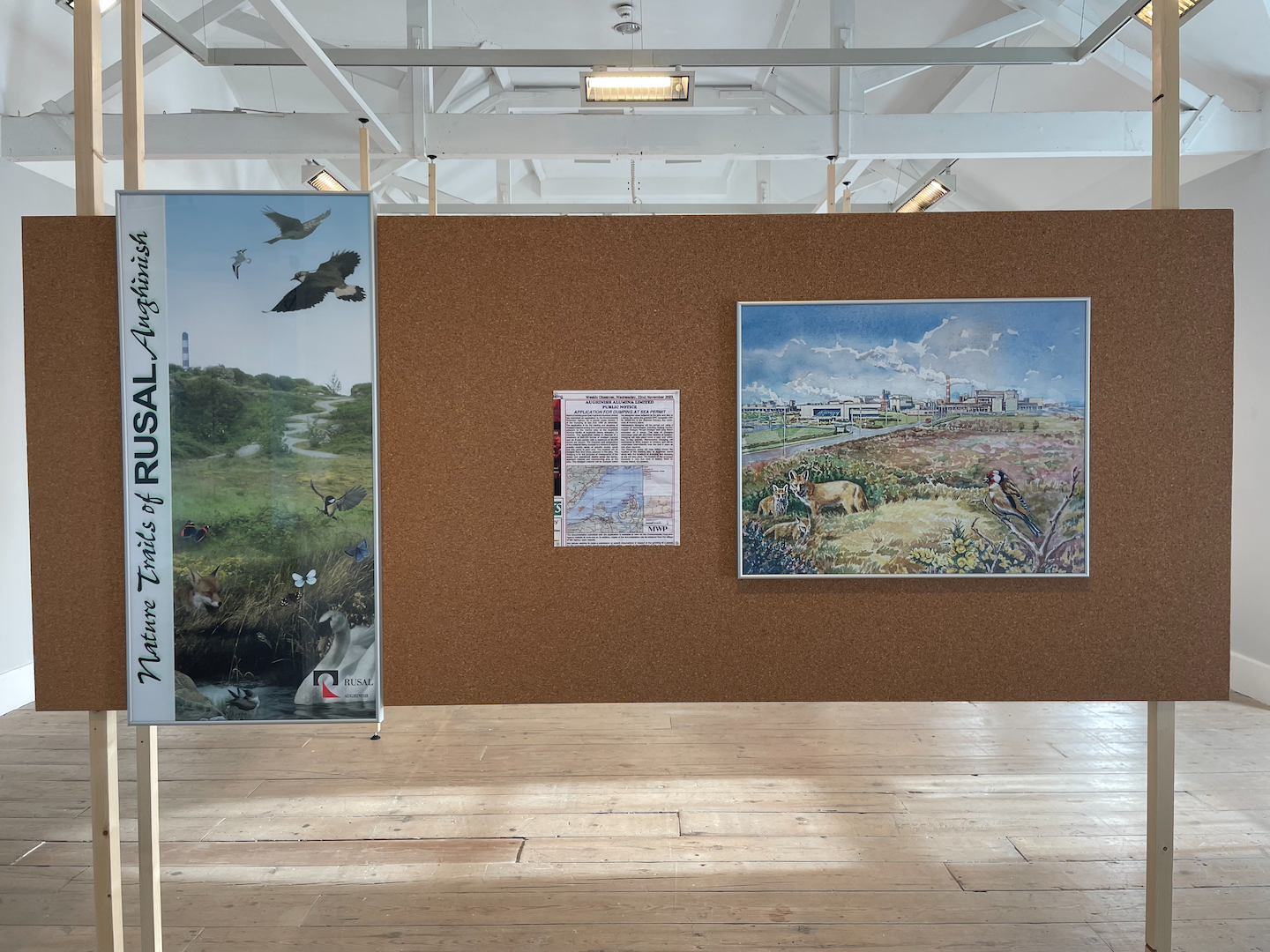
By establishing the viewer as a co-collaborator in the production of meaning, the exhibit undermines the possibility of a subject-viewer examining museum objects. It resists the kinds of “museumized” representations that marginalized many communities on the lower Shannon, such as the Abbey Fishermen. 86 Instead, the Stigma Damages exhibit connects the visitor with the processes of aluminum production and pollution to which they bear witness as it also exposes and revises knowledge hierarchies. Institutionalized epistemological frameworks often impose a subject-scientist as an authority over objects of study, a hierarchy often mirrored in museum collections and their provenance. As Rodney Harrison and Colin Sterling explain: “Far from being relics of the past, museums are increasingly called upon to help shape a more just and sustainable future. Museums are also deeply entrenched in broader histories of colonialism, globalisation and capitalism.” 87 Horrigan’s curation engages the gallery space as a medium through which to formally challenge many of the persisting subject-object hierarchies on display. This necessitates the active participation of the viewer in processes of meaning making while refusing an objectively reproducible view from the outside.
The newspaper clippings from the Limerick Leader, Weekly Observer, and Alcan company newsletters pinned on corkboard throughout the exhibit highlight and challenge institutionalized knowledge hierarchies. The scientific studies represented in the pinned objects reveal the refinery’s efforts to evade culpability. After numerous residents came forward with concerns about corrosive red dust on homes, gardens, and cars, the articles show scientists to attribute the material to algae, low temperatures, and the Sahara Desert. Nowhere in the exhibit does Horrigan comment on or offer interpretations of specific objects or their connection to one another.
Rather, the curation of the exhibit allows the visitor to encounter how time and again state, scientific, and industry authorities subordinate local knowledge to sustain industry. Environmental justice activists have encountered and challenged these knowledge hierarchies for decades, often advocating for independent and citizen science as they confront the question, as Nelta Edwards puts it, “how might we begin to move toward an epistemology that includes a commitment to sustainability?” 88 To imagine possible epistemologies and ontologies in which social and environmental sustainabilities might play a primary rather than secondary role to economic and state sustainabilities, Horrigan’s curation tasks the visitor with connecting the dots that accumulate throughout the exhibit.
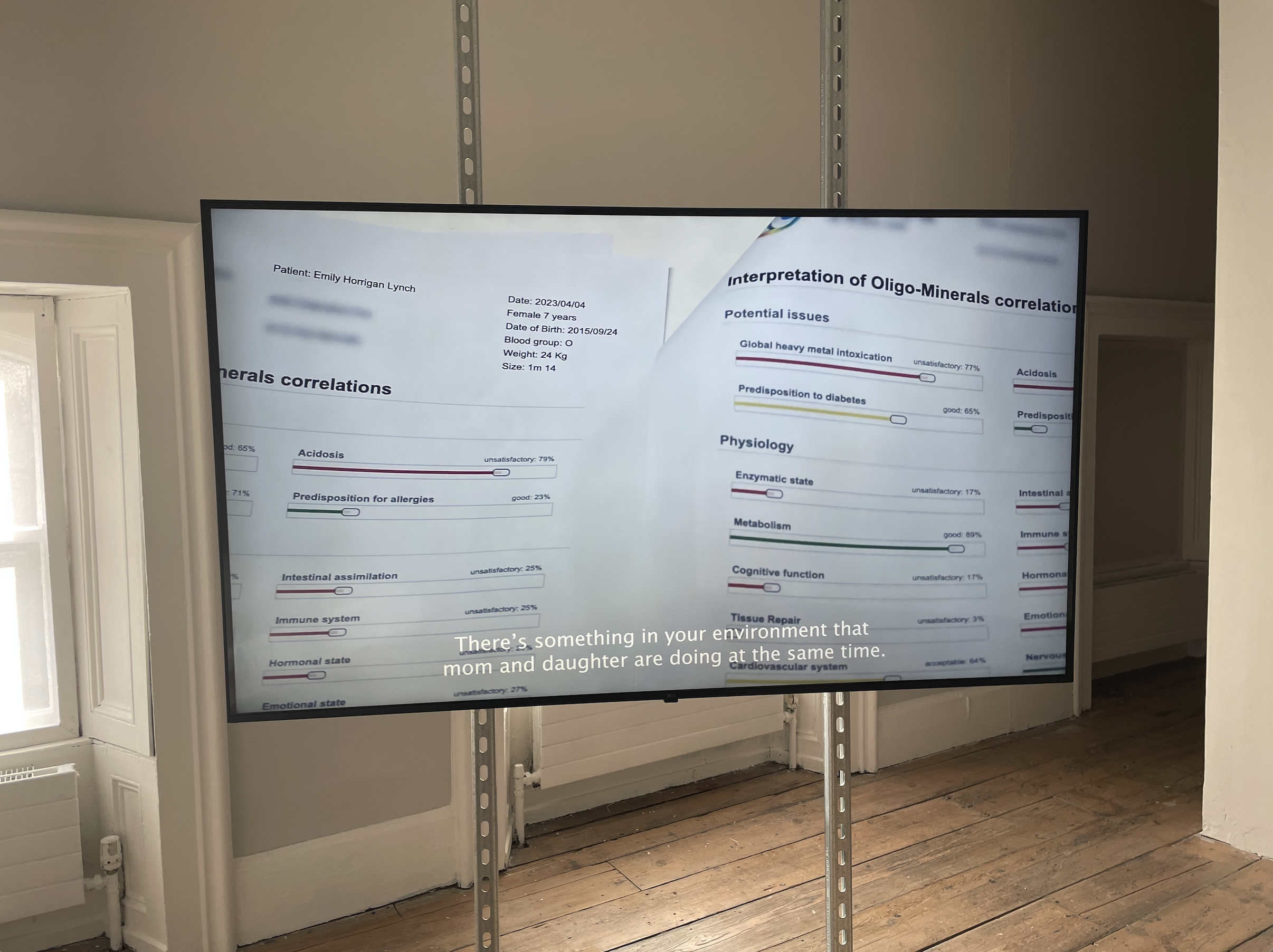
The curation allows meaning to gradually accumulate as it permeates multiple ongoing and collaborative interactions among the viewer, materials on display, and museum space. These formal elements reflect and present an alternative to the accumulation of toxins the exhibit’s varied content describes. One of the first rooms that visitors encounter contains a short video of Horrigan and her daughter getting tested for heavy metals in their bodies (see Figure 14). The toxic levels of aluminum they are both found to carry confronts the viewer with the intergenerational harm environmental injustices impose on human and more-than-human communities. Almost hidden from sight behind the video installation is an adjacent room where bauxite rocks lie on top of a projector enlarging the results of the test onto a wall. This dark room behind the opening video installation emphasizes the way harm often accumulates hidden from view. Horrigan and her family become representatives for the burdens that people, animals, plants, and environments in and around Askeaton bear to sustain the aluminum industry and its supply chains. This video installation aurally echoes across and merges with other video installations in the exhibit. By putting these permeabilities on display, both through its use of the space and its content, Horrigan’s exhibit and curation collectively expand the possibilities for how to remain engaged with and in a toxic world, or as Donna Haraway famously puts it, for “staying with the trouble.” 89
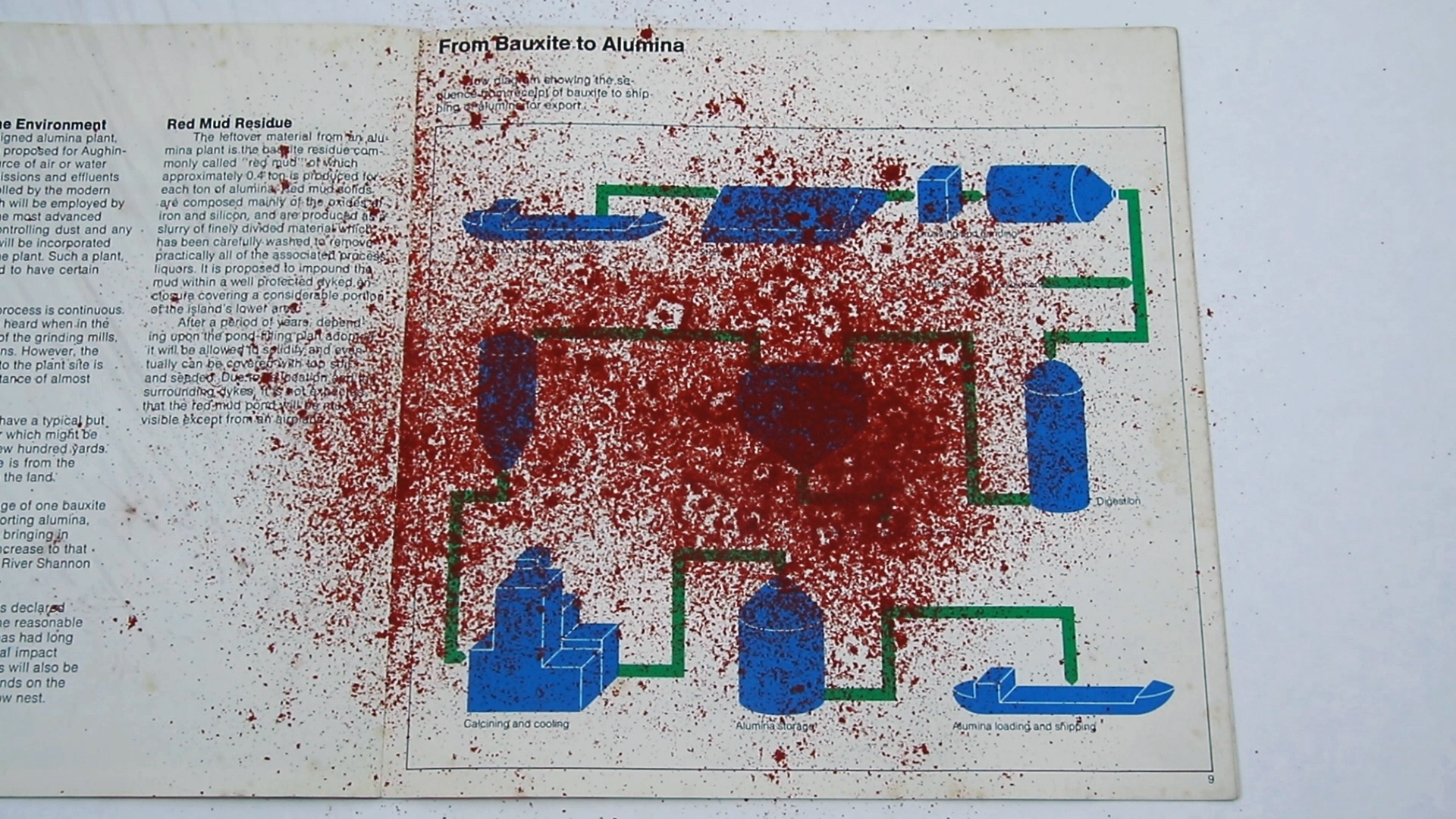
These themes of accumulation persist in the Stigma Damages exhibit on which I collaborated with Horrigan to host at Tilburg University in the spring of 2025 (see Figure 17). In that exhibit, accumulation featured in Horrigan’s video installation about Askeaton, which repeatedly shows an hourglass from various angles. Red powder gradually fills the bottom bulb, ending with a close-up of the hourglass as time literally runs out. The accumulation of red dust recurs later when the video shows a promotional brochure comprising a diagram of the bauxite to alumina refining process. The diagram's green arrows connecting blue steps associate the industry with natural elements of land and water. In the center of the diagram, a funnel shows the “mud thickening” step, from which “red mud residue impoundment” funnels out the bottom and disappears into the white page, seemingly leaving no mark. Yet red granules gradually obscure the image in the video as Horrigan narrates where the toxic red dust falls in the environment surrounding the refinery in west Limerick (see Figure 15).
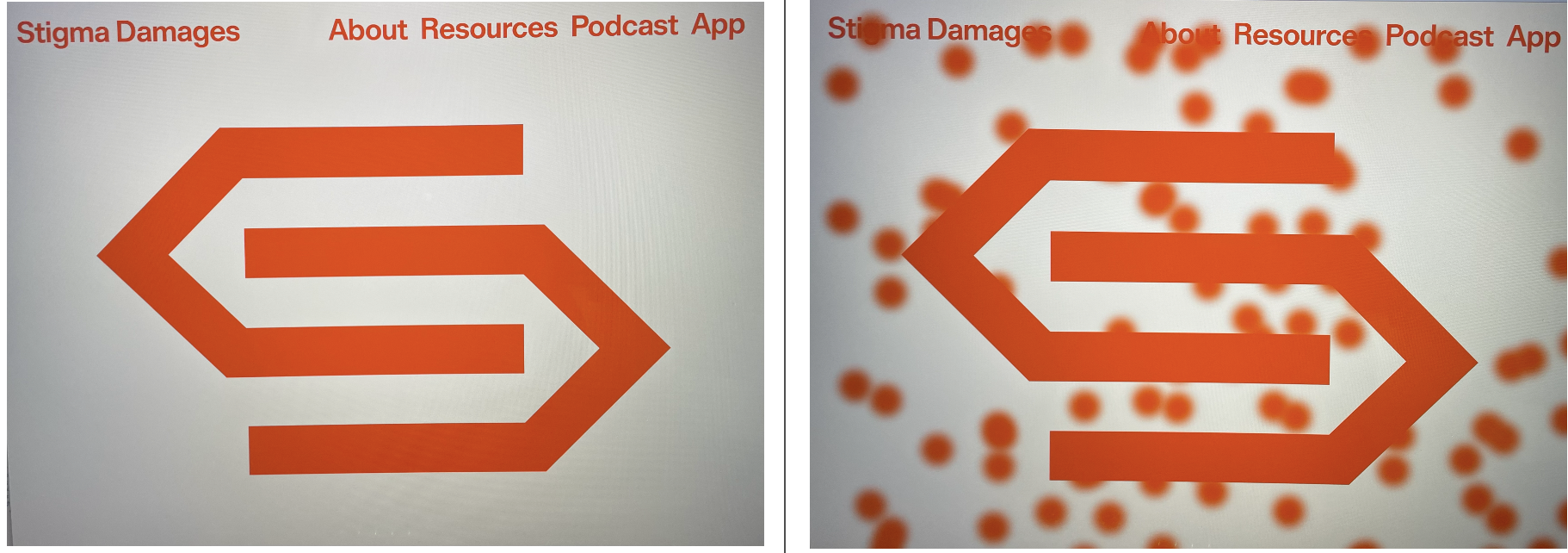
These representations of accumulating pollution in multiple Stigma Damages exhibits foreground interconnections among bodies, environments, and industry in Askeaton but also wherever viewers encounter Horrigan’s Stigma Damages, including online. The Stigma Damages website formally reflects the accumulation and permeability of bodies and environments depicted in the content and curation of the exhibits. Red dots gradually cover Stigma Damages webpages where users remain inactive, thereby reflecting how viewers play an active role in the accumulation of toxic red mud beside the refinery through their passive consumption of everyday technologies (see Figure 16). Like so many products, digital technologies require aluminum and other elements extracted, produced, disseminated, and disposed of in polluting processes that disproportionately harm marginalized communities, often in rural regions and historically colonially underdeveloped postcolonial nations like the Republic of Ireland. The refinery’s pollution certainly disproportionately impacts communities in Askeaton and the surrounding region, but Horrigan’s Stigma Damages immerses viewers in sounds and meanings that expose our collective entanglement and complicity in environmental injustices that gradually accrue in efforts to sustain the status quo.
Enduring Multispecies Future
Bringing postcolonial ecocritical, environmental justice theory, and ecomedia studies lenses to cultural expression of industrialization of the lower River Shannon over the past century reveals how, as Julian Agyeman, Robert D. Bullard, and Bob Evans write, “justice and sustainability are intimately linked and mutually interdependent.” 90 The arts-based imaginings of environmental systems in Keating’s paintings, the assertions of multispecies sustainability over multiple generations in the Abbey Fishermen’s protests and legacy, and Ryan’s photography of reworking and reclaiming land in Moyross combine with the permeability and accumulation in Horrigan’s Stigma Damages exhibits in co-implicated and embodied meaning-making processes. The more traditional and realist depictions of changing environments on the lower River Shannon reveal critically reflective approaches as the realities of human and more-than-human communities are irreparably altered in the name of progress. The cultural expression of these changing environments indicates how, to use the words of T.J. Demos, “socially concerned and politically active artists have taken up the ambition of intervening in the world, and have done so by reengaging and reinventing the documentary mode.” 91 Where much business and governmental policy retains a national focus to “meet the needs” of select human communities today and in the future, attending to artistic representations reveals innovative, integrated, and alternative understandings of multispecies and environmental interdependence that integrate tradition and history into a shifting present moment that extends into collective futures. The artistic representations examined in this article consequently reframe and reimagine more inclusive understandings of the collective needs of human and more-than-human communities to which discourses and policies of sustainability should attend and work to protect in an uncertain era of planetary pollution.
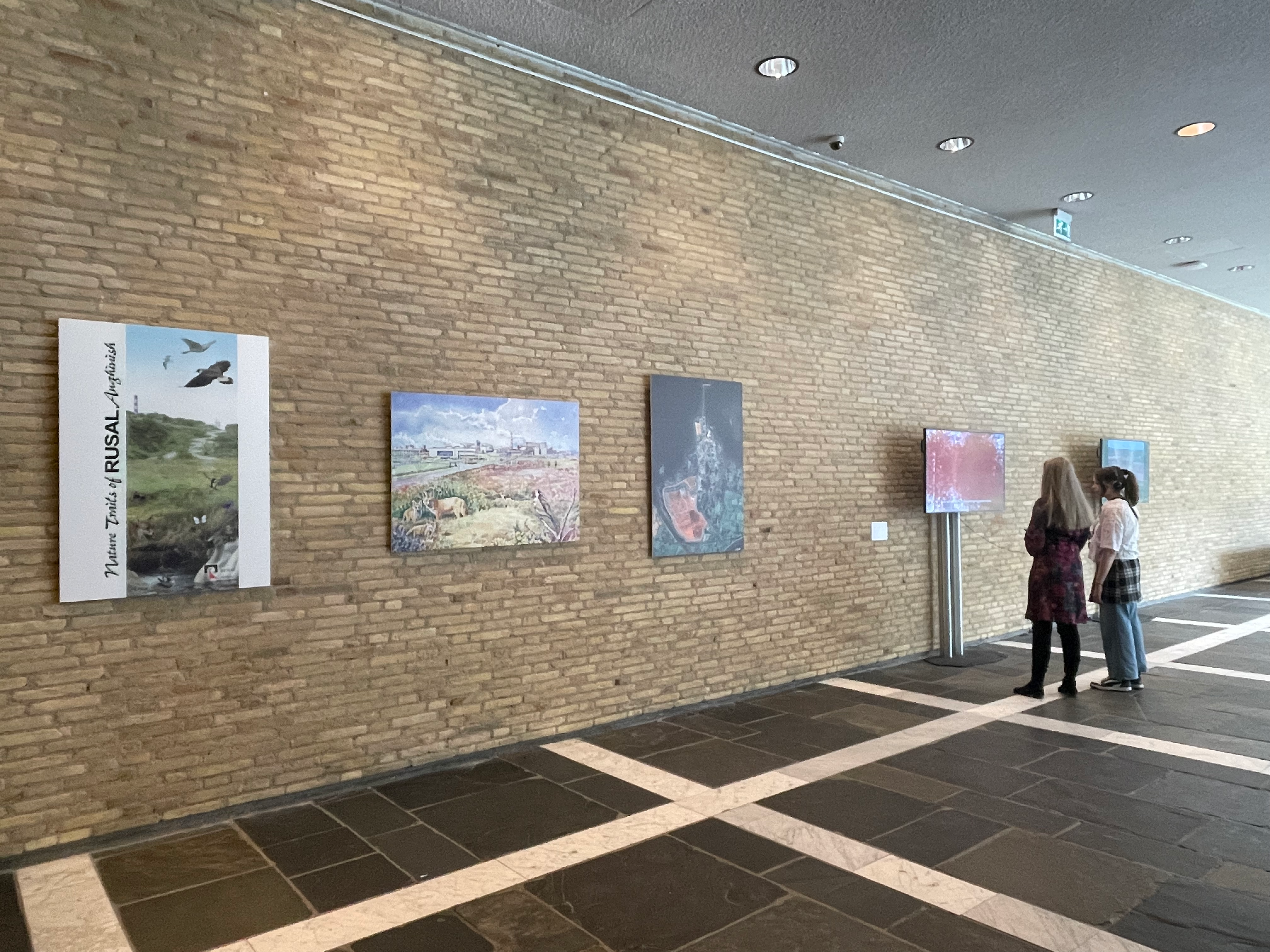
Image Credits and Acknowledgments
This story map was written and created by the Katherine M. Huber for the American Journal for Irish Studies.
All images in this story map are either published under a CC license or have been included with the explicit permission of their respective copyright owners. Any copying or distribution of individual images appearing here is expressly forbidden without permission from the copyright holders. All rights reserved.
I am very grateful to the ESB Archives for providing the permissions to quote materials and include images of Seán Keating's paintings. I am also exceedingly thankful to Michele Horrigan, Liz Ryan, and the Askeaton Contemporary Arts for providing the permissions to include image materials in this article.
Notes
Ruth Delaney, The Shannon Navigation (Dublin: The Lilliput Press, 2008), 4, 83.
Sorcha O’Brien, Powering the Nation: Images of the Shannon Scheme and Electricity in Ireland (Irish Academic Press, 2017), 164-93, 192.
William Lysaght, The Abbey Fishermen: A Short History of the Snap Net Fishermen of Limerick (The Treaty Press, 1965), National Library of Ireland BB7600; Sharon Clancy, The Abbey Fishermen: History and culture of a fishing community (Bloomington: Trafford Publishing, 2006); Michael McCarthy, High Tension: Life on the Shannon Scheme (Dublin: The Lilliput Press, 2004), 10, 154-5.
O’Brien, Powering the Nation, 192.
Kosatica et al., “Introduction,” 4.
“Sustainability,” United Nations Academic Impact, 2025, https://www.un.org/en/academic-impact/sustainability. The European Union has a similar definition that consequently also raises questions about whose needs matter, both today and in the future. See “Sustainability,” European Environment Agency, 2025, https://www.eea.europa.eu/en/topics/at-a-glance/sustainability
See, for example, Julian Agyeman, Robert D. Bullard, and Bob Evans, “Joined-up Thinking: Bringing Together Sustainability, Environmental Justice, and Equity,” in Just Sustainabilities: Development in an Unequal World, ed. Julian Agyeman, Robert D. Bullard, and Bob Evans (Earthscan, 2003), 1-16.
Julie Sze, Anne Rademacher, Tom Beamish, Liza Grandia, Jonathan London, Louis Warren, Beth Rose Middleton, and Mike Ziser, “Introduction,” in Sustainability: Approaches to Environmental Justice and Social Power, ed. Julie Sze (New York University Press, 2018), 6.
Mark Maguire, “The space of the nation: History, culture and a conflict in modern Ireland,” Irish Studies Review 6, no. 2 (1998): 118; O’Brien, Powering the Nation, 33; Sharae Deckard, “Energy Futures in Contemporary Irish Fiction,” in A History of Irish Literature and the Environment, ed. by Malcolm Sen (Cambridge: Cambridge University Press, 2022), 383. Ella McSweeney, “Ardnacrusha is an ecological catastrophe that has devastated the Shannon and its salmon,” The Irish Times, 2 November 2024, https://www.irishtimes.com/environment/2024/11/02/as-long-as-ardnacrusha-is-in-operation-the-shannon-and-its-salmon-will-never-recover/
Michael McCarthy, High Tension: Life on the Shannon Scheme (Dublin: The Lilliput Press, 2004), 27; Éimear O’Connor, Seán Keating: Art, Politics and Building the Irish Nation (Dublin: Irish Academic Press, 2013), 160; O’Brien, Powering the Nation, vii.
O’Brien, Powering the Nation, 12, 16; O’Hearn, Atlantic Economy, 112; Conrad et al., “Introduction,” 4.
Bird, Dúnlaith. “‘You Know What She Died of, Mother Pegg? Of Darkness…’ Seán Keating, the Shannon Scheme, and Samuel Beckett,” Samual Beckett Today / Aujourd’hui 35 (2023), 70; McCarthy, High Tension, 57, 99, 109, 164.
O’Connor Seán Keating: Art, 139, 156; Justin Dolan Stover, Enduring Ruin: Environmental Destruction During the Irish Revolution (Dublin: University College Dublin Press, 2022), 53-54.
O’Brien, Powering the Nation, 172; Éimear O’Connor Seán Keating in Context: Responses to Culture and Politics in Post-Civil War Ireland (Bray: Carysfort Press, 2009), 6; O’Connor, Seán Keating: Art, 161.
Quoted in Éimear O’Connor, Seán Keating and the ESB: Enlightenment and Legacy (Dublin: Royal Hibernian Academy, 2012), 47.
O’Connor, Seán Keating: Art, 179; O’Connor, Seán Keating and the ESB, 145.
O’Connor, Seán Keating in Context, 63.
O’Connor, Seán Keating: Art, 174.
O’Connor, Seán Keating: Art, 164-165.
O’Connor, Seán Keating: Art, 174-175; O’Brien, Powering the Nation, 178-179; Michael Rubenstein, Public Works: Infrastructure, Irish Modernism, and the Postcolonial (Notre Dame: University of Notre Dame Press, 2010), 150-151.
Jason W. Moore, Capitalism in the Web of Life: Ecology and the Accumulation of Capital (London and New York: Verso Press, 2015), 37.
Carolyn Merchant, The Death of Nature: Women, Ecology, and the Scientific Revolution (New York: HarperCollins, 1983), 2.
Irish Labour Party and Trade Union Congress, Thirty-Second Annual Report: The National Executive, 1926, National Library of Ireland, 33188i2, 19-20, 106; McCarthy, High Tension, 39-41, 153-165.
McCarthy, High Tension, 56-58; 98-105.
McCarthy, High Tension, 109.
“Sustainability,” United Nations Academic Impact, 2025, https://www.un.org/en/academic-impact/sustainability
William Lysaght, The Abbey Fishermen: A Short History of the Snap Net Fishermen of Limerick (Cork: The Treaty Press, 1965). 20. Found in the National Library of Ireland, BB7600.
Peadar O’Donnell, “Limerick Fishermen Attacked,” An Phoblacht, 23 July 1932, Irish News Archives. https://www.irishnewsarchive.com/
Colin Graham, Deconstructing Ireland: Identity, Theory, Culture (Edinburgh: Edinburgh University Press, 2001), 12.
Maguire, “Space of the Nation,” 118.
Maguire, “Space of the Nation,” 114.
McSweeney, “Ardnacrusha,” Irish Times.
Lysaght, Abbey Fishermen, 5, 4.
Clancy, Abbey Fishermen, 32.
Lysaght, Abbey Fishermen, 22.
Michael Hayes, “Abbey Fishermen and Loss of Living: Letter from Secretary of Guild,” Limerick Leader, 18 November 1936. Irish News Archives. December 2024. https://www.irishnewsarchive.com/
ESB. Electricity Supply Board Annual Report, 1934-1935. ESB Archives, 14.
ESB. Electricity Supply Board Annual Report, 1935-1936. ESB Archives, 17; ESB, Electricity Supply Board Annual Report, 1936-1937. ESB Archives, 18.
Callum Roberts, The Unnatural History of the Sea, (Washington D.C.: Island Press/Shearwater Books, 2007), 341.
ESB, Electricity Supply Board Annual Report, 1931-1932, ESB Archives, 11.
“Sustainability,” United Nations Academic Impact, 2025, https://www.un.org/en/academic-impact/sustainability
McSweeney, “Ardnacrusha,” Irish Times.
Lysaght, Abbey Fishermen, 47.
Niamh Hourigan, editor. Understanding Limerick: Social Exclusion and Change (Cork: Cork University Press, 2011), 47.
Liz Ryan, Under Starry Skies, Askeaton Contemporary Arts, 2017.
See Martin J. Power, Patricia Neville, Eoin Devereux, Amanda Haynes, and Cliona Barnes, “‘Why bother seeing the world for real?’: Google Street View and the representation of a stigmatised neighbourhood,” New Media & Society 15, no. 7 (2012); Hourigan, Understanding Limerick.
Ryan, Under Starry Skies.
Patrick Bresnihan, Transforming the Fisheries: Neoliberalism, Nature, and the Commons (Lincoln: University of Nebraska Press, 2016), 128, emphasis in original.
Jon Axline, Taming Big Sky Country: The History of Montana Transportation from Trails to Interstates (Cheltenham: The History Press, 2015), 91-94; Robert Fletcher, “Open Range,” Your Daily Poem, 2026, https://www.yourdailypoem.com/listpoem.jsp?poem_id=1878
Ryan, Under Starry Skies.
Elizabeth Butler Cullingford, Ireland's Others: Gender and Ethnicity in Irish Literature and Popular Culture (Notre Dame: University of Notre Dame in association with Field Day Press, 2001), 183.
Power et al., “‘Why bother seeing the world for real?’” 1034, 1030-31.
McCarthy, High Tension, 10, 154-155.
Ryan, Under Starry Skies.
Jennifer Green-Lewis, Framing the Victorians: Photography and the Culture of Realism (Ithica: Cornell University Press, 1996), 4, 223; Siobhan Angus, Camera Geologica: An Elemental History of Photography (Durham and London: Duke University Press, 2024), 6.
Angus, Camera Geologica, 38.
Angus, Camera Geologica, 92, 201.
Angus, Camera Geologica, 15.
“The Confederated Tribes of the Umatilla Indian Reservation,” Columbia River Inter-Tribal Fish Commission, 2026, https://critfc.org/member-tribes-overview/the-confederated-tribes-of-the-umatilla-indian-reservation/
Hannah Arendt, The Human Condition [1958], 2nd Edition (Chicago: The University of Chicago Press, 2018), 55.
“Sustainability,” United Nations Academic Impact, 2025, https://www.un.org/en/academic-impact/sustainability
Allen, No Global, 221; Lorna Siggins, Once Upon a Time in the West: The Corrib Gas Controversy (London: Transworld Ireland, 2010), 217-221; Ramachandra Guha and Joan Martinez Aller, Varieties of Environmentalism: Essays North and South (London: Routledge, 1997), xiv.
Cindi Katz, “Whose Nature, Whose Culture? Private productions of space and the ‘preservation’ of nature,” in Remaking Reality: Nature at the Millenium, ed. by Bruce Braun and Noel Castree (London: Routledge, 1998), 46; Sarah Jaquette Ray, The Ecological Other: Environmental Exclusion in American Culture (Tucson: University of Arizona Press, 2013), 16; Allen, No Global, 222-223; Guha et al., Varieties of Environmentalism, xiii; Michele Horrigan, Michele Horrigan, https://michelehorrigan.com/
Rita O’Reilly, “Kremilin-linked firms and banks control Aughinish Alumina owner,” RTÉ, 13 April 2022, https://www.rte.ie/news/primetime/2022/0407/1291077-kremlin-linked-firms-banks-control-aughinish-owner/
Allen, No Global, 204, 214; Mimi Sheller, Aluminum Dreams: The Making of Light Modernity (Cambridge: MIT Press, 2014), 17-18; Michele Horrigan, Michele Horrigan, https://michelehorrigan.com.
Allen, No Global, 208; O’Brien, Powering the Nation, 167-168.
Michele Horrigan, Stigma Damages. https://www.stigmadamages.com/
Michelle Murphy, “Distributed Reproduction, Chemical Violence, and Latency,” The Scholar & Feminist Online 11, no. 3 (2013), https://sfonline.barnard.edu/distributed-reproduction-chemical-violence-and-latency/ ; Andra Simpson, “Who Hears Their Cry? African American Women and the Fight for Environmental Justice in Memphis, Tennessee,” in The Environmental Justice Reader: Politics, Poetics, and Pedagogy, ed. by Joni Adamson, Mei Mei Evans, and Rachel Stein (Tucson: The University of Arizona Press, 2002), 100.
Horrigan, “Episode 1: Vince Puccio,” Stigma Damages, https://www.stigmadamages.com/podcast , 6:00-6:45.
Julie Sze, Anne Rademacher, Tom Beamish, Liza Grandia, Jonathan London, Louis Warren, Beth Rose Middleton, and Mike Ziser, “Introduction,” in Sustainability: Approaches to Environmental Justice and Social Power, ed. by Julie Sze (New York: New York University Press, 2018), 14.
Thomas J. Barone and Elliot W.W. Eisner, Arts Based Research (Thousand Oaks: SAGE Publications, 2011), 1.
Maguire, “Space of the Nation,” 118.
Rodney Harrison and Colin Sterling, “Rethinking museums for the climate emergency,” in Critical Heritage Studies and the Futures of Europe, ed. by Rodney Harrison, Nélia Dias, and Kristian Kristiansen (London: UCL Press, 2023), 15.
Nelta Edwards, “Radiation, Tobacco, and Illness in Point Hope, Alaska: Approaches to the ‘Facts’ in Contaminated Communities,” in The Environmental Justice Reader: Politics, Poetics, and Pedagogy, ed. by Joni Adamson, Mei Mei Evans, and Rachel Stein (Tucson: The University of Arizona Press, 2002), 117.
Donna J. Haraway, Staying with the Trouble: Making Kin in the Chthulucene (Durham and London: Duke University Press, 2016).
Julian Agyeman, Robert D. Bullard, and Bob Evans, “Joined-up Thinking: Bringing Together Sustainability, Environmental Justice, and Equity,” in Just Sustainabilities: Development in an Unequal World, ed. by Julian Agyeman, Robert D. Bullard, and Bob Evans (London: Earthscan, 2003), 3, emphasis in original.
T.J. Demos, The Migrant Image: The Art and Politics of Documentary during Global Crisis (Durham and London: Duke University Press, 2013), xvii.
Patrick Henry Pearse, “From a Hermitage,” Irish Freedom, 1 October 1913. Irish News Archives. https://www.irishnewsarchive.com/
Bronwyn A. Ormsby, Joyce H. Townsend, Brian W. Singer, and John R. Dean, “British Watercolour Cakes from the Eighteenth to the Early Twentieth Century,” Studies in Conservation 5, no. 1 (2005), 47-48.
Stacy Alaimo, Exposed: Environmental Politics & Pleasures in Posthuman Times (Minneapolis: University of Minnesota Press, 2016), 178.
O’Brien, Powering the Nation, 35.
O’Brien, Powering the Nation, 226.
O’Connor, Seán Keating: Art, 174.
O’Connor, Seán Keating: Art, 165.
O’Brien, Powering the Nation, 35–36.
Nerea Calvillo, Aeropolis: Queering Air in Toxicpolluted Worlds (New York: Columbia Books, 2023), 161.
O’Connor, Seán Keating: Art, 172.